
It’s 2 a.m., your child is finally asleep, and you realize the bottle of liquid amoxicillin has been sitting in the back of the fridge since last Tuesday. You check the label. It says "Discard after 14 days." But wait-when exactly did you mix it? Was it Monday? Or was it Friday? This anxiety is common for parents dealing with reconstituted antibiotic suspensions, which are powdered medications mixed with water to create a liquid form suitable for children or adults who cannot swallow pills. Unlike solid pills that can sit on a shelf for years, these liquids have a ticking clock. Once mixed, they start degrading. Using them past their prime isn't just wasteful; it risks under-dosing your child, leading to treatment failure or antibiotic resistance.
The Science Behind the Short Shelf Life
To understand why these medicines expire so quickly, we need to look at chemistry. Most liquid antibiotics belong to the beta-lactam family, including amoxicillin and ampicillin. These molecules are stable as dry powders but fragile in water. When a pharmacist adds distilled water to the powder-a process called reconstitution-the chemical bonds begin to break down through a reaction called hydrolysis. Think of it like opening a bag of chips; once air gets in, they go stale. With antibiotics, water is the enemy of stability.
This instability is not a manufacturing defect; it's an inherent property of the drug. According to data from the United States Pharmacopeia (USP), these drugs must maintain at least 90% of their labeled potency to be considered effective. Once degradation pushes potency below this threshold, the medicine is technically expired, even if it looks fine. The rate of this breakdown depends heavily on temperature. Research published in the American Journal of Hospital Pharmacy shows that for every 10°C increase in temperature, the degradation rate roughly doubles. This means leaving a bottle on the kitchen counter instead of the fridge can cut its usable life in half.
How Long Do Different Antibiotics Last?
Not all liquid antibiotics share the same expiration date. The timeline depends on the specific drug and whether it contains additional ingredients. Here is a breakdown of common shelf lives when stored correctly in the refrigerator (2-8°C):
- Amoxicillin (alone): Typically stable for 14 days. This is the standard for simple infections like ear infections or strep throat.
- Amoxicillin/Clavulanate (Augmentin): Stable for only 10 days. The addition of clavulanic acid makes the mixture more unstable.
- Ampicillin: Generally stable for 7 to 10 days, depending on the formulation.
- Cephalexin: Often stable for 10 to 14 days.
Why does adding clavulanate shorten the shelf life? Clavulanic acid is a beta-lactamase inhibitor designed to help the antibiotic fight resistant bacteria, but chemically, it is very unstable in water. Studies by Jassim (2010) indicate that potassium clavulanate loses potency significantly faster than amoxicillin alone, especially at room temperature. At 27-29°C, clavulanate drops below 90% potency in just five days. This is why combination drugs require stricter discard timelines. If you have a 14-day prescription for Augmentin, you will likely need a second refill or a new bottle to complete the course, as the first bottle expires before the treatment ends.
| Antibiotic Type | Refrigerated Shelf Life | Room Temp Shelf Life | Key Instability Factor |
|---|---|---|---|
| Amoxicillin | 14 days | 5-7 days | Hydrolysis of beta-lactam ring |
| Amoxicillin/Clavulanate | 10 days | 5 days | Rapid degradation of clavulanate |
| Ampicillin | 7-10 days | 5 days | pH sensitivity |
| Cephalexin | 10-14 days | Varies | Oxidation |

Storage Mistakes That Ruin Medication Faster
Even if you follow the calendar, physical handling can ruin the drug sooner. One major mistake is transferring the liquid to another container. A study by Tu et al. (1988) found that moving clavulanate-potassium from its original glass bottle into oral syringes reduced its stability from over 11 days to less than 5 days, even when refrigerated. The plastic in syringes or secondary containers can interact with the drug or allow micro-leakage of air, accelerating degradation. Always keep the medication in the original bottle provided by the pharmacy.
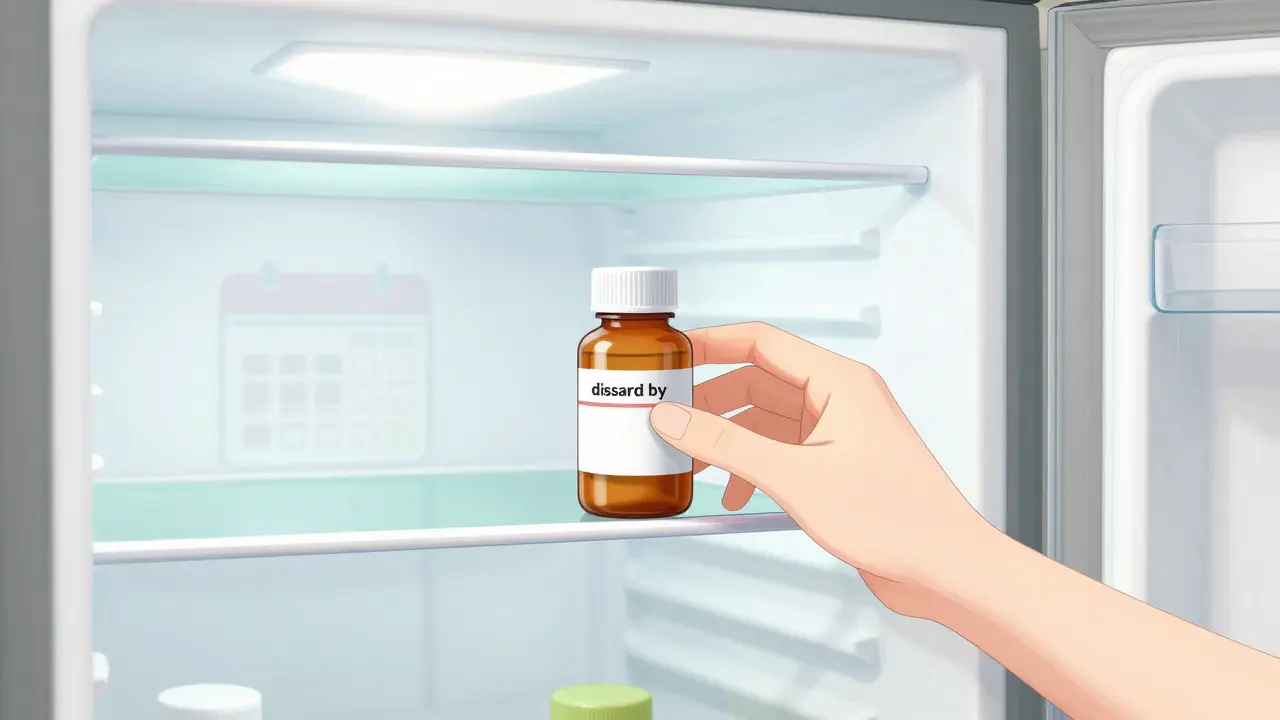
Another critical error is improper refrigeration. The ideal temperature range is 2°C to 8°C (36°F to 46°F). Many home fridges fluctuate outside this range, especially if the door is opened frequently or if the bottle is placed near the cooling element where it might freeze. Freezing can damage the suspension structure, causing particles to clump. While some studies suggest freezing extends shelf life for certain antibiotics in hospital settings, this is not recommended for home use unless explicitly directed by a pharmacist. Conversely, storing the bottle at room temperature is a common oversight. If you leave amoxicillin on the counter, its shelf life shrinks from 14 days to potentially just 5 or 7 days. Check the label; most manufacturers specify "Refrigerate" clearly.
Light exposure is another silent killer. Beta-lactam antibiotics are sensitive to light, which can trigger photodegradation. This is why many liquid antibiotic bottles are amber-colored or opaque. If your bottle is clear, store it inside a cabinet or a dark part of the fridge rather than on a transparent shelf facing the light. Simple behavioral changes, like writing the reconstitution date and the exact discard date on the label with a permanent marker immediately after mixing, can prevent accidental use of expired meds. Pharmacists often report that up to 22% of patients accidentally use expired reconstituted antibiotics simply because they forgot when they mixed it.
Signs Your Antibiotic Has Gone Bad
Can you tell if the antibiotic is still good? Sometimes, yes. Visual inspection is your first line of defense. Freshly mixed antibiotics should be uniform in color and texture. Signs of degradation include:
- Cloudiness or Particulates: If you see floating bits or the liquid looks murky, discard it. This indicates precipitation or microbial growth.
- Color Changes: Amoxicillin typically turns darker brown or yellowish as it degrades. If the color is significantly different from when you first mixed it, it’s likely lost potency.
- Sedimentation: Some suspensions naturally settle. However, if shaking doesn’t return the liquid to a smooth consistency, the formulation may have broken down.
However, visual checks are not foolproof. A drug can lose potency without changing appearance. Relying solely on looks is risky. The safest approach is strict adherence to the printed discard date. If you are unsure about the date, do not guess. Contact your pharmacist. They can look up the batch record or advise based on the specific product. Taking sub-potent antibiotics is dangerous because it exposes bacteria to low doses, encouraging them to develop resistance. This makes future infections harder to treat.
Practical Tips for Managing Short Shelf Lives
Dealing with short shelf lives requires planning. If your child’s infection resolves quickly, don’t save the leftover medicine for later. It is likely already degraded. Instead, dispose of it properly. Flush small amounts of hazardous liquids if instructed by local guidelines, or take them to a pharmacy take-back program. Do not pour large quantities down the drain without checking environmental regulations.
For longer courses, consider asking your doctor about alternative formulations. Newer technologies are emerging to address this issue. For example, some companies are developing dual-chamber systems that keep the powder and liquid separate until the moment of use, potentially extending shelf life to 30 days. While these aren't widely available yet, discussing options with your provider can help. In the meantime, set phone reminders for the discard date. Apps like CVS Script Sync or simple calendar alerts can reduce the risk of using expired meds. Finally, always ask the pharmacist to write the "Mix Date" and "Discard By" date directly on the label. Don’t assume they will remember to do this; request it explicitly during pickup.
Can I freeze liquid antibiotics to extend their shelf life?
Generally, no. While some hospital studies show freezing can preserve potency for specific antibiotics like amoxicillin for up to 60 days, this is not recommended for home use. Freezing can alter the suspension's texture, cause separation, or damage the bottle. Unless your pharmacist explicitly instructs you to freeze a specific medication, keep it refrigerated. Thawing and refreezing cycles can also degrade the drug further.
What happens if I give my child expired liquid antibiotics?
The primary risk is under-dosing. As the antibiotic degrades, its potency drops below therapeutic levels. This means the bacteria causing the infection may not be fully killed, leading to treatment failure. Worse, partial exposure can promote antibiotic resistance, making the bacteria harder to kill with future treatments. In rare cases, degradation products could cause allergic reactions or stomach upset, though efficacy loss is the main concern.
Why does Amoxicillin/Clavulanate expire faster than plain Amoxicillin?
Clavulanic acid, the additive in combination drugs like Augmentin, is chemically unstable in water. It breaks down much faster than amoxicillin alone. While plain amoxicillin can last 14 days in the fridge, the clavulanate component may drop below 90% potency in just 10 days. Therefore, the entire mixture must be discarded after 10 days to ensure both components remain effective.
Is it safe to transfer liquid antibiotics to a smaller travel bottle?
No, it is not recommended. Transferring the liquid to another container, such as an oral syringe or a travel cup, can introduce contaminants and expose the drug to air and light. Studies show that moving clavulanate-containing antibiotics to plastic syringes can reduce their stability from over 11 days to less than 5 days. Always use the original manufacturer-approved bottle to maintain stability.
How do I know if my refrigerator is cold enough for antibiotics?
Antibiotics should be stored between 2°C and 8°C (36°F to 46°F). Most home fridges operate within this range, but temperatures can fluctuate. Avoid placing the bottle in the door, where temperature swings are greatest due to frequent opening. Instead, store it on a middle shelf in the main compartment. If you suspect your fridge is too warm, use a thermometer to check. Consistent cold storage is key to maximizing the 10-14 day shelf life.