

Vilazodone Diarrhea Symptom Tracker
Track Your Diarrhea Symptoms
This tool helps you track your diarrhea symptoms and understand what to expect based on clinical data.
Your Progress
Enter your symptoms to see personalized guidance
When you start taking vilazodone (brand name Viibryd) for depression, the last thing you expect is to spend your first week in the bathroom. But for nearly 1 in 3 people, that’s exactly what happens. Diarrhea isn’t just a minor annoyance-it’s the most common side effect of vilazodone, hitting 26% to 29% of users. That’s more than double the rate you’d see with placebo, and higher than most other antidepressants. If you’re one of them, you’re not broken. You’re not failing. You’re just adjusting.
Why Vilazodone Causes Diarrhea
Vilazodone works differently than most antidepressants. It’s not just a serotonin reuptake inhibitor like SSRIs. It’s a SPARI-serotonin partial agonist and reuptake inhibitor. That means it doesn’t just block serotonin from being reabsorbed; it also gently activates certain serotonin receptors in your brain and gut. That dual action is why it’s less likely to cause sexual side effects or weight gain. But it’s also why your digestive system gets stirred up. Your gut has a ton of serotonin receptors. When vilazodone hits them, it speeds up gut motility. Food moves faster. Fluid doesn’t get absorbed properly. Result? Loose stools. It’s not an infection. It’s not food poisoning. It’s your nervous system reacting to a new chemical signal.How Long Does It Last?
The good news? For most people, it doesn’t last long. Clinical trials show that 94% of diarrhea cases are mild to moderate. And over 68% of users report it clears up within two weeks. Median duration? Just seven days. That means if you stick it out, your body likely adjusts before you even notice you’re missing the bathroom trips. But here’s the catch: if you stop taking it too soon, you won’t know if it would’ve gotten better. Many people quit around day 10, only to find out later that their symptoms faded by day 14. That’s why doctors push you to keep going-even when it’s uncomfortable.The One Thing That Makes the Biggest Difference
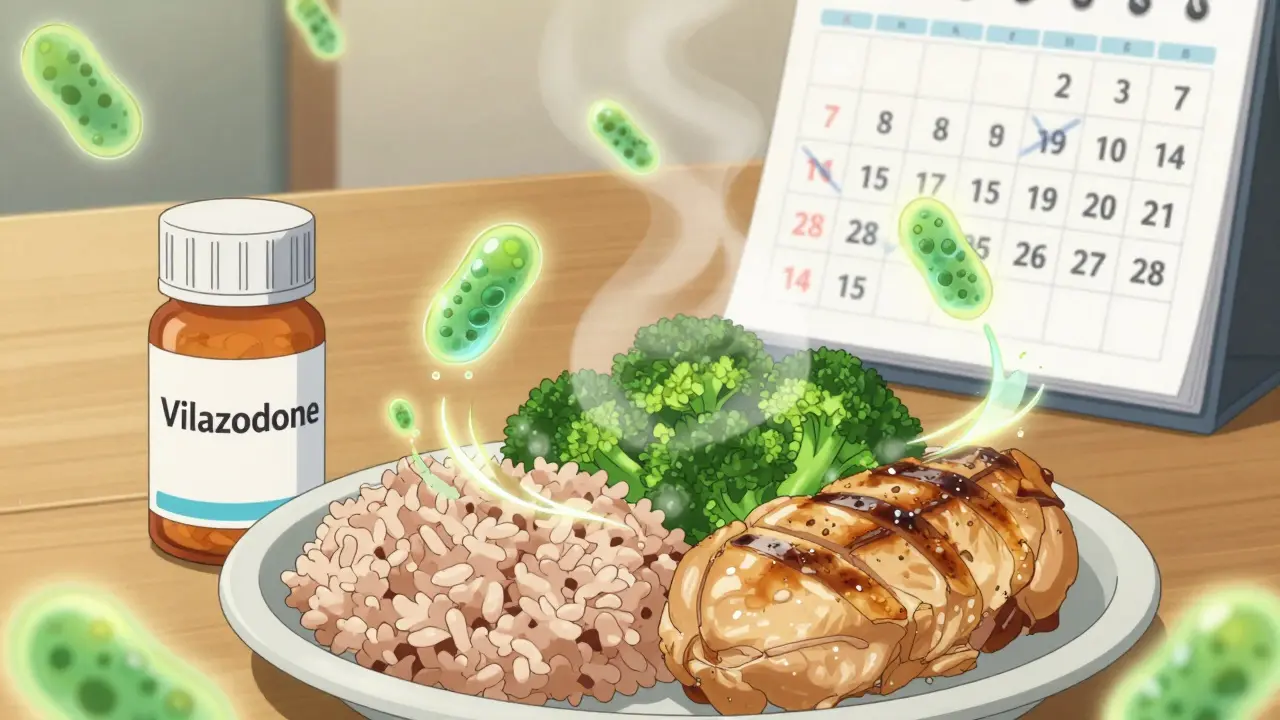
You’ve probably heard to take vilazodone with food. But most people don’t realize how much that matters. The FDA says you need at least 500 calories with your dose. Not a snack. Not a banana. A full meal. Why? Because vilazodone’s absorption jumps by 60% when taken with food. But more importantly, food slows down how fast the drug hits your system. That reduces the spike in serotonin that triggers diarrhea. People who take it on an empty stomach are far more likely to have severe symptoms. Real-world data shows 74% of users who managed their diarrhea did so by always taking it with a balanced meal-protein, complex carbs, healthy fats. Think grilled chicken with brown rice and broccoli. Not toast and coffee.What to Eat (and Avoid)
Your diet plays a bigger role than you think. Here’s what works:- soluble fiber: Oats, bananas, applesauce, and psyllium husk help absorb excess water in the gut. Aim for 10-15 grams daily.
- probiotics: Strains like Lactobacillus rhamnosus GG and Bifidobacterium longum have been shown in studies to cut diarrhea rates by nearly half. Look for refrigerated supplements with at least 10 billion CFUs.
- hydration: Drink water, broth, or oral rehydration solutions. Avoid sugary drinks-they make diarrhea worse.
Avoid these:
- caffeine: Coffee, energy drinks, even chocolate can stimulate bowel movements.
- artificial sweeteners: Sorbitol, mannitol, and xylitol (common in sugar-free gum and diet sodas) are notorious for causing loose stools.
- fried or spicy foods: They irritate the gut lining and speed up digestion.
When to Use Loperamide (Imodium)
If your diarrhea is really bad in the first week, loperamide can help. It slows down your gut so your body has more time to absorb water. Many users swear by it. But don’t just grab it off the shelf. Talk to your doctor first. The standard dose is 2 mg after the first loose stool, then 1 mg after each additional loose stool-not more than 8 mg in 24 hours. Don’t use it for more than 48 hours without checking in. It’s a band-aid, not a fix.What If It Doesn’t Go Away?
If diarrhea lasts longer than two weeks, or if you’re having more than six bowel movements a day, it’s time to call your doctor. Same if you develop fever, blood in stool, or signs of dehydration (dizziness, dark urine, dry mouth). About 10% of people end up switching medications because the diarrhea doesn’t improve. That’s not failure. It’s just biology. Bupropion, sertraline, or escitalopram might be better fits. Some people feel better on them even if vilazodone worked better for their mood.Why Vilazodone Is Still Worth Considering
Yes, the diarrhea is rough. But vilazodone has a unique advantage: it’s one of the few antidepressants that doesn’t wreck your sex life. Studies show only 2-3% of users report low libido-compared to 25-70% with other SSRIs and SNRIs. That’s huge for people who’ve quit other meds because of sexual side effects. It also doesn’t cause weight gain like mirtazapine or paroxetine. For someone who’s struggled with both depression and body image, that matters. The FDA approved it in 2011. It’s not new. But because of its side effects, it’s been underused. Now that the patent expired and generics are available, more doctors are prescribing it-with better guidance on how to manage the GI issues.
Dosing Strategy That Works
The manufacturer recommends starting at 10 mg daily for a week, then increasing to 20 mg for another week, then 40 mg. That’s not a suggestion-it’s a protocol designed to reduce side effects. Some doctors now stretch it even slower: 10 mg for 10 days, then 20 mg for 14 days, then 40 mg. That extra time lets your gut adapt. If you’re prone to GI issues, ask about this slower ramp-up.What the Experts Say
Dr. John Preston from UC Davis says: “The key to managing vilazodone’s GI side effects is gradual dose escalation and consistent administration with meals.” Dr. Charles Nemeroff adds: “While diarrhea remains the most common adverse effect, its transient nature in most patients makes vilazodone a viable option for many who can’t tolerate other antidepressants.” And Dr. Stephen Stahl, a leading psychopharmacologist, puts it bluntly: “Its high rate of GI side effects may limit its utility as a first-line treatment despite its favorable sexual side effect profile.” That’s the trade-off. It’s not the best for everyone. But for the right person, it’s the best.Real Stories
One Reddit user, ‘AnxiousEngineer,’ wrote: “Started with 10mg, got terrible diarrhea the first week. My doctor told me to keep going, and by week 3 it was completely gone. Now on 40mg for 6 months with no issues.” Another user on Drugs.com, ‘DepressedMom,’ said: “After 3 weeks of constant diarrhea and cramping, my doctor switched me to bupropion-life changing.” There’s no right answer for everyone. But there is a right path for you-if you’re willing to stick with it long enough to find out.What to Do Next
If you’re on vilazodone and dealing with diarrhea:- Take it with a meal of at least 500 calories-every single day.
- Add soluble fiber and a probiotic with proven strains (L. rhamnosus GG or B. longum).
- Avoid caffeine, artificial sweeteners, and fried foods.
- Drink plenty of water.
- Don’t panic if it’s bad in week one. Wait until week three before deciding.
- Call your doctor if it lasts beyond two weeks, gets worse, or you feel dehydrated.
You didn’t choose this drug because it was easy. You chose it because you wanted relief without losing yourself in the process. That’s worth fighting for.
Is diarrhea from vilazodone dangerous?
In most cases, no. Vilazodone-induced diarrhea is mild to moderate and not dangerous. It’s a side effect of how the drug affects serotonin in your gut, not an infection or serious condition. But if it lasts longer than two weeks, causes dehydration, fever, or blood in stool, you should contact your doctor immediately. These could signal something more serious.
Can I take Imodium with vilazodone?
Yes, loperamide (Imodium) is generally safe to use short-term with vilazodone. Many people use it in the first week to manage severe diarrhea. Take 2 mg after the first loose stool, then 1 mg after each additional loose stool, but don’t exceed 8 mg in 24 hours. Don’t use it for more than two days without talking to your doctor. It’s a temporary fix, not a long-term solution.
How long does it take for vilazodone to start working?
Most people notice mood improvements between 4 to 6 weeks, though some feel small changes as early as week 2. The diarrhea usually clears up before the antidepressant effects fully kick in, so don’t stop the medication just because you feel worse physically at first. Stick with it. The physical side effects often fade before the mental ones fully arrive.
Will switching to a generic version change my side effects?
No. Generic vilazodone contains the same active ingredient as the brand-name Viibryd. The FDA requires generics to be bioequivalent, meaning they work the same way in your body. Side effects like diarrhea won’t change just because the pill looks different or costs less. What matters is how you take it-with food, at the right dose, and with proper timing.
Can I take vilazodone with other antidepressants?
No. Vilazodone should not be combined with other antidepressants like SSRIs, SNRIs, or MAOIs without strict medical supervision. Doing so can cause serotonin syndrome-a rare but serious condition with symptoms like confusion, rapid heart rate, high blood pressure, and muscle rigidity. Always tell your doctor about every medication or supplement you’re taking.
Is vilazodone better than sertraline or escitalopram?
It depends on what side effects matter most to you. Vilazodone has a higher rate of diarrhea (26-29%) than sertraline (18%) or escitalopram (6%), but much lower rates of sexual dysfunction. If you’ve stopped other meds because of low libido or weight gain, vilazodone might be worth the GI trade-off. If diarrhea is your biggest concern, sertraline or escitalopram may be easier to tolerate.
Should I stop vilazodone if I get diarrhea?
Don’t stop without talking to your doctor. Most diarrhea improves within 1-2 weeks. Stopping too early means you won’t know if it would’ve resolved. If you’re unsure, track your symptoms daily. If it gets worse or lasts beyond two weeks, then it’s time to discuss alternatives. But don’t quit on day 7 because it’s uncomfortable. Give your body time to adapt.
Nelly Oruko
January 13, 2026 AT 22:39It’s wild how something so biologically precise-serotonin receptors in the gut-can feel so personal. Like your body’s screaming at you, but it’s not mad at you. It’s just adjusting. I’ve been on vilazodone for 8 months now. Week one was brutal. Week two? Still bad. Week three? Quiet. And now? I feel like myself for the first time in years. No sexual side effects. No weight gain. Just… peace. And yeah, I take it with a full damn meal. Always.
Trevor Whipple
January 14, 2026 AT 19:48lol so u just gotta eat a big meal? wow i never thought of that. i was just taking it with coffee and a donut and wonderin why i was in the bathroom every 20 min. thanks for the life hack, doc.
Lethabo Phalafala
January 15, 2026 AT 13:06I was crying in the bathroom at 3 a.m. on day four. I thought I was dying. Or that I’d chosen the wrong path. But I kept going. Took the probiotic. Ate oatmeal with peanut butter and banana every morning. And then-poof. One morning, I didn’t run to the toilet. I just… sat. And drank my tea. And cried again. But this time, it was because I felt human again.
Lance Nickie
January 15, 2026 AT 16:50Yeah right. Like everyone’s gonna eat 500 calories with their antidepressant. That’s not advice, that’s a lifestyle upgrade. Next you’ll tell me to meditate while I poop.
sam abas
January 16, 2026 AT 23:46Let’s be real-this whole article reads like a pharmaceutical ad disguised as medical advice. Yes, vilazodone has lower sexual side effects. But 29% of users get diarrhea? That’s not a trade-off-that’s a dealbreaker for most. And the ‘take it with food’ advice? That’s not science, that’s common sense. Anyone who doesn’t know that shouldn’t be prescribing SSRIs. Also, loperamide is not a band-aid-it’s a godsend for people who can’t function. Stop acting like it’s dangerous. It’s not heroin. And the ‘wait two weeks’ mantra? That’s just fearmongering. Some people’s guts don’t adapt. And that’s okay. There are other meds. Sertraline’s fine. Escitalopram’s fine. You don’t need to martyr yourself for a drug that makes you feel like you’re in a bad anime.
John Pope
January 17, 2026 AT 09:17Ah yes, the serotonin paradox: the same neurotransmitter that lifts the soul also tortures the bowels. It’s poetic, really. A divine irony-our psyche’s salvation is written in the gut’s rebellion. We are not just minds, nor just bodies-we are neurochemical symphonies, and vilazodone? It’s the dissonant chord that must be resolved. The gut is our second brain, after all. And when it screams, it’s not just signaling digestion-it’s screaming for integration. So yes, eat your 500-calorie meal. But also, sit with the discomfort. Breathe. Let the serotonin flow. Let the gut adapt. This isn’t medicine. This is alchemy.
Clay .Haeber
January 17, 2026 AT 23:04Oh wow. So if I just eat a steak dinner before my antidepressant, I won’t be a weakling anymore? Cool. Next time I get diarrhea, I’ll just blame myself for not eating enough avocado toast. Meanwhile, my doctor’s still on vacation and I’m in a Target bathroom wondering if I’m gonna die or just need a new pair of pants.
Adam Vella
January 19, 2026 AT 16:07The data presented here is methodologically sound, but the framing lacks critical nuance. The 26–29% incidence rate of diarrhea is accurate, yet the normalization of this side effect risks minimizing patient suffering. Furthermore, the recommendation to use loperamide is not without risk-particularly in populations with comorbid cardiac conditions. While dietary mitigation is empirically supported, the assumption that all patients can access or afford high-calorie, nutrient-dense meals is classist and unrealistic. A more equitable approach would prioritize dose titration protocols and pharmacogenetic screening over meal planning. This is not a lifestyle adjustment-it’s a pharmacological challenge requiring clinical oversight.
Anny Kaettano
January 19, 2026 AT 20:10To everyone struggling: you’re not broken. You’re not weak. You’re doing the hardest thing-showing up for yourself when your body feels like it’s betraying you. I’ve been there. I took vilazodone with a big breakfast every day. I added that probiotic. I drank broth. I didn’t quit. And one morning, I woke up and realized-I hadn’t thought about the bathroom in three days. That’s the moment you get back your life. You’re not alone. Keep going. I’m rooting for you.
Vinaypriy Wane
January 21, 2026 AT 01:48...I...I took it with a banana...and...and coffee...I didn't know...I thought...I thought it was just...me...I'm sorry...I didn't know...I'm trying now...I'm eating oatmeal...with peanut butter...and...and I'm taking the probiotic...I'm not giving up...
Diana Campos Ortiz
January 22, 2026 AT 20:03Just wanted to say-this post saved me. I was ready to quit after day 5. Now I’m on week 3. No diarrhea. Just me. And my oatmeal. And my peace. Thank you.