
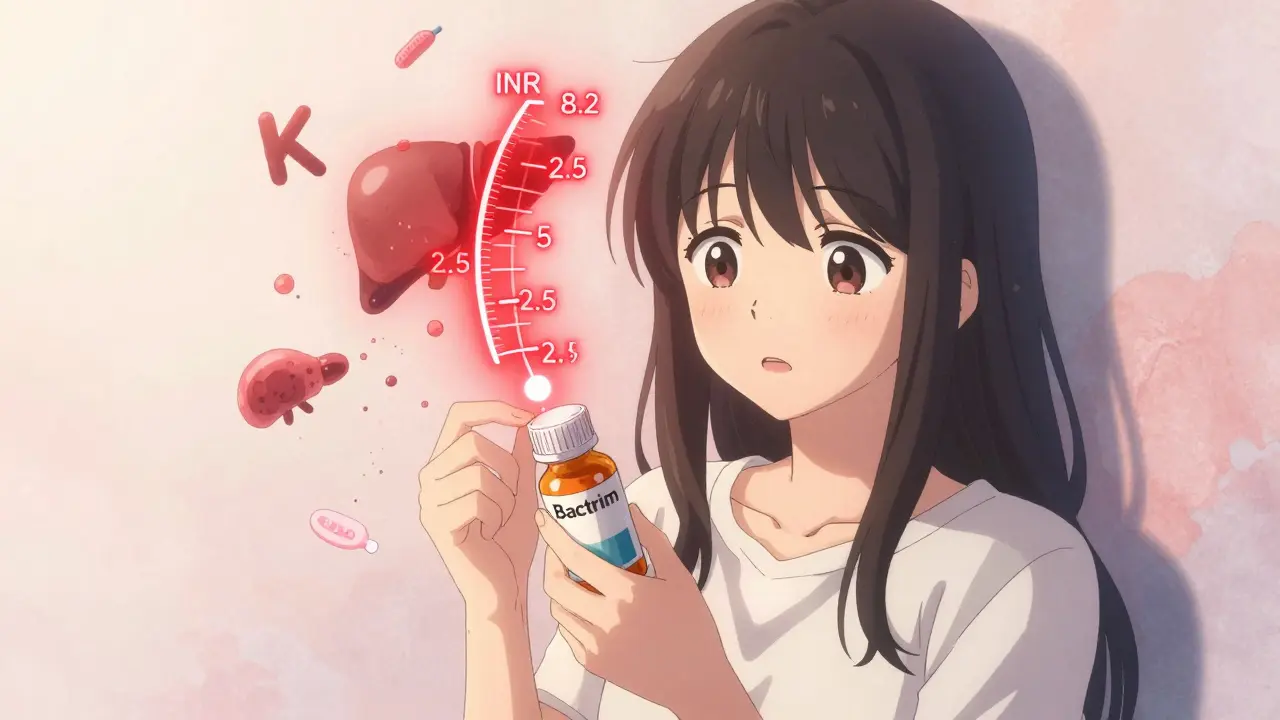
Warfarin-TMP-SMX Interaction Calculator
Calculate Your INR Risk
This tool estimates how much your INR might increase when taking trimethoprim-sulfamethoxazole (Bactrim) while on warfarin. Based on your personal factors and the article's research showing average 1.8-unit INR increase.
Your Risk Assessment
Estimated INR
Risk Factors
- Age:
- Liver Function:
- Vitamin K Intake:
- Gender:
Recommended Actions
INR < 5.0
Hold 1-2 warfarin doses. Resume at 20-30% lower dose. Recheck INR in 2-3 days.
INR 5.0-9.0
Give oral vitamin K (1-2.5 mg). Monitor closely. Avoid invasive procedures.
INR > 9.0
Give IV vitamin K (5-10 mg) + 4-factor prothrombin complex concentrate. Hospitalize.
When you're on warfarin, even a simple antibiotic can turn dangerous. Take trimethoprim-sulfamethoxazole - commonly known as Bactrim or Septra - a go-to treatment for urinary tract infections, sinus infections, and pneumonia. It’s cheap, effective, and widely prescribed. But if you're taking warfarin for atrial fibrillation, a mechanical heart valve, or deep vein thrombosis, this combo can send your INR soaring - sometimes to life-threatening levels.
Why This Interaction Is So Dangerous
Warfarin works by blocking vitamin K, which your body needs to make clotting factors. It’s a tightrope walk: too little, and you clot; too much, and you bleed. Your INR (International Normalized Ratio) measures this balance. For most people on warfarin, the target is between 2.0 and 3.0. Once it hits 4.0, your bleeding risk starts climbing. At 5.0 or higher, the danger becomes serious - and with TMP-SMX, it can jump that fast. The problem isn’t just one thing. It’s a triple threat:- CYP2C9 inhibition: TMP-SMX slows down how your liver breaks down the more powerful part of warfarin (S-warfarin). This causes warfarin to build up in your blood.
- Protein displacement: Both drugs cling tightly to albumin in your bloodstream. When TMP-SMX shows up, it kicks warfarin off its binding sites, freeing up more active drug to work.
- Gut flora disruption: Sulfamethoxazole kills off bacteria in your intestines that produce vitamin K. Less vitamin K means warfarin works even harder.
This isn’t theoretical. A 2023 study tracking over 70,000 warfarin patients found that those taking TMP-SMX had an average INR increase of 1.8 units - more than four times the rise seen with amoxicillin. For some, INR jumped from 2.5 to over 6.0 in just 72 hours.
Who’s at Highest Risk?
Not everyone reacts the same way. Some people take Bactrim with no change in INR. Others end up in the ER. Why the difference?- Age over 75: Older adults metabolize drugs slower. Their livers and kidneys aren’t as efficient.
- Liver disease: If your liver can’t process warfarin well to begin with, adding TMP-SMX pushes it over the edge.
- Low vitamin K intake: People who eat little green leafy vegetables or have poor nutrition have less backup vitamin K to fight warfarin’s effects.
- Heart failure: Poor circulation means drugs linger longer in the bloodstream.
- Male sex: Studies show men are 9% more likely than women to experience dangerous INR spikes - possibly due to differences in body weight, enzyme activity, or medication adherence.
One nurse practitioner in South Africa told me about a 78-year-old man on warfarin for a mechanical mitral valve. He got a UTI. His doctor prescribed Bactrim. Three days later, his INR was 8.2. He started bleeding from his gums and had blood in his urine. He needed vitamin K and fresh frozen plasma to stabilize.
How Fast Does It Happen?
Timing matters. The INR rise doesn’t come on day one. It typically starts showing up between 36 and 72 hours after you take your first dose of TMP-SMX. That’s why so many patients get caught off guard. They feel fine. They assume the antibiotic is safe. Then, suddenly, they’re dizzy, bruising easily, or bleeding without cause.By day 4, the interaction is usually at its peak. Waiting until you notice symptoms is too late. That’s why experts say: Check your INR before starting TMP-SMX, then again at 48 and 72 hours.

What Do Doctors Do When INR Spikes?
There’s no one-size-fits-all fix. It depends on how high your INR is and whether you’re bleeding.| INR Range | Bleeding? | Recommended Action |
|---|---|---|
| 4.0-5.0 | No | Hold 1-2 warfarin doses. Resume at 20-30% lower dose. Recheck INR in 2-3 days. |
| 5.0-9.0 | Minor (bruising, nosebleeds) | Give oral vitamin K (1-2.5 mg). Monitor closely. Avoid invasive procedures. |
| 9.0+ | Minor or major | Give IV vitamin K (5-10 mg) + 4-factor prothrombin complex concentrate (PCC). Hospitalize. |
| Any level | Severe (vomiting blood, head injury, internal bleeding) | Immediate PCC + IV vitamin K. Emergency care. Stop TMP-SMX. |
Never try to fix this yourself. Vitamin K reverses warfarin, but giving too much can make your blood too thick - increasing your risk of clots later. Only a doctor should decide the dose.
Alternatives to TMP-SMX
If you’re on warfarin and need an antibiotic, there are safer options.- Nitrofurantoin: First-line for UTIs. Minimal interaction with warfarin.
- Amoxicillin: Safe for most infections. INR changes are minor and rarely clinically significant.
- Cephalexin: A cephalosporin with low interaction risk.
- Fosfomycin: Single-dose option for uncomplicated UTIs.
Fluoroquinolones like ciprofloxacin? They’re risky too - they raise INR by about 0.9 units on average. Not as bad as TMP-SMX, but still not safe without monitoring.
Doctors at the University of Arkansas and the American Society of Hematology agree: avoid TMP-SMX if possible. If no alternatives exist - say, for a resistant infection - then proceed with extreme caution: check INR within 48 hours, reduce warfarin dose preemptively, and monitor daily.

What Patients Should Do
If you’re on warfarin:- Always tell every doctor, pharmacist, and nurse you’re taking it - even for a simple cold.
- Ask: "Is this antibiotic safe with warfarin?" Don’t assume it is.
- If you’re prescribed TMP-SMX, schedule an INR test before you start and again at 48 and 72 hours.
- Watch for signs of bleeding: unusual bruising, pink or red urine, black stools, nosebleeds that won’t stop, headaches, dizziness.
- Keep a log of your INR values and any new medications. Bring it to every appointment.
Patients who received specific counseling about antibiotic interactions had 37% fewer emergency visits for bleeding, according to the National Blood Clot Alliance. Knowledge saves lives.
The Bigger Picture
Even though newer blood thinners like apixaban and rivaroxaban (DOACs) are replacing warfarin for many people, over 2.6 million Americans still take warfarin in 2025. And TMP-SMX? It’s still the 47th most prescribed antibiotic in the U.S.A 2022 study in JAMA Internal Medicine found nearly 1 in 5 warfarin patients got a potentially dangerous antibiotic within 30 days. TMP-SMX made up almost 30% of those cases. That’s not just a mistake - it’s a systemic gap in care.
Researchers are now building predictive tools - using genetics, age, and baseline INR - to guess who’s most likely to have a bad reaction. Early results show 82% accuracy. In the future, your pharmacist might flag this interaction before you even leave the pharmacy.
For now, though, the rule is simple: When you’re on warfarin, treat TMP-SMX like a loaded gun. It’s not always dangerous - but when it is, it’s catastrophic.
Frequently Asked Questions
Can I take Bactrim if I’m on warfarin?
Bactrim (TMP-SMX) should be avoided if possible when you’re on warfarin. It can cause your INR to spike dangerously within 2-3 days. If no other antibiotic will work, your doctor may allow it - but only with close INR monitoring and a likely reduction in your warfarin dose.
How long does the INR elevation last after stopping Bactrim?
Once you stop TMP-SMX, your INR usually starts coming down within 2-4 days. But it can take up to a week to return to baseline, depending on your liver function and how high the INR went. Don’t assume it’s safe to go back to your old warfarin dose right away. Your doctor should adjust it gradually based on follow-up INR tests.
Does vitamin K reverse the effect of TMP-SMX?
No. Vitamin K reverses warfarin’s effect - not the antibiotic itself. TMP-SMX keeps working in your body for a few days after you stop taking it. Vitamin K helps lower your INR, but you still need to monitor your levels until the antibiotic clears out completely.
Are there any natural supplements I should avoid with warfarin and TMP-SMX?
Yes. Avoid supplements like garlic, ginkgo, ginger, ginseng, and fish oil - they can increase bleeding risk on their own. Also, avoid large amounts of vitamin K-rich foods (kale, spinach, broccoli) if you’re trying to lower your INR. Consistency matters more than avoidance. Eat the same amount of these foods daily to keep your INR stable.
Why do some people not have any INR changes with TMP-SMX?
Everyone’s metabolism is different. Some people have genetic variants that make CYP2C9 work faster or slower. Others have healthier gut bacteria that keep producing vitamin K. Age, liver function, and diet all play a role. That’s why blanket rules don’t work - you can’t predict who’s safe. That’s why monitoring is non-negotiable.
Frank Drewery
December 18, 2025 AT 14:13This is one of those posts that should be printed and taped to every pharmacy counter. I had a cousin who ended up in the ER after a simple UTI script. No one warned him. He thought antibiotics were just pills you take. Scary stuff.
Thanks for laying it out so clearly. Even as a layperson, I get it now.
mary lizardo
December 20, 2025 AT 09:34One must wonder why this interaction remains so poorly understood by primary care providers, given that it has been documented in peer-reviewed literature since at least 2005. The continued prescription of trimethoprim-sulfamethoxazole in anticoagulated patients reflects a systemic failure in pharmacological education, not merely an oversight.
Furthermore, the use of the term 'Bactrim'-a brand name-in a clinical context is linguistically inappropriate and indicative of a troubling trend toward casual medical communication. One would hope for greater precision from healthcare communicators.
Sajith Shams
December 21, 2025 AT 20:07You're all missing the real issue. This isn't about warfarin or antibiotics-it's about lazy doctors prescribing like they're ordering coffee. I've seen this exact scenario in India: old man on warfarin, gets Bactrim for a cough, INR hits 9, family panics. No monitoring. No follow-up. Just 'take this pill.'
And don't even get me started on nitrofurantoin being 'safe.' In patients with renal impairment? It's a death sentence too. Everyone's just copying each other without thinking. The real answer? Stop prescribing antibiotics unless you're willing to monitor INR daily. Period.
Chris Davidson
December 22, 2025 AT 14:27Been on warfarin for 12 years. Took Bactrim once for a sinus infection. Didn't check my INR. Got a nosebleed that wouldn't stop. Took 3 days to get to the clinic. My INR was 7.8
Don't be like me. Get tested. Don't wait for bleeding. The warning is right there. You just choose to ignore it
Glen Arreglo
December 24, 2025 AT 13:30I'm from the Philippines and we see this all the time. In our rural clinics, Bactrim is the go-to for everything because it's cheap and available. No labs. No monitoring. People just take it.
But I’ve also seen patients who were warned, tracked their INR, and avoided disaster. Knowledge isn’t power here-it’s survival. We need community health workers to educate families, not just doctors. This isn't just a US problem.
Also, props to the author. You didn’t just dump data. You made it human.
Isabel Rábago
December 24, 2025 AT 22:59It's disgusting that doctors still prescribe this combo without a second thought. People are dying because of arrogance and laziness. You think your patient will be fine? You're not a fortune teller. You're a doctor. Check the INR. Or don't write the script.
And don't even get me started on how patients are expected to be their own advocates. What if they're elderly? Illiterate? Scared? This isn't about personal responsibility-it's about medical malpractice disguised as standard care.
Monte Pareek
December 25, 2025 AT 22:12I've been a clinical pharmacist for 18 years and I can tell you this interaction is one of the top three most dangerous in outpatient care. I've had to call ERs at 2am because a patient’s INR spiked after Bactrim and they didn’t know to call. And here's the kicker-it's preventable. Every single time.
Here's what I tell my patients: if you're on warfarin and your doctor says 'take this antibiotic,' say 'I need to check my INR before and after.' If they roll their eyes? Find a new doctor. Seriously.
Also, if you're on warfarin and your pharmacist gives you a warning sticker? Don't ignore it. That sticker is the result of someone losing a patient. I've seen it. It's not a suggestion. It's a lifeline.
And yes, fluoroquinolones are risky too. But TMP-SMX? It's the silent killer. It doesn't make you sick. It makes you bleed from the inside out. And by the time you feel it, you're already in trouble. Get tested. Three days in. No excuses.
I wish I had a dollar for every time someone said 'I didn't think it would matter.' It matters. It always matters.
Allison Pannabekcer
December 27, 2025 AT 06:29Thank you for writing this. I'm a nurse who works with elderly patients on warfarin, and I can't tell you how many times I've had to explain this to families who think 'antibiotic' means 'safe.'
One of my patients, a 79-year-old woman, took Bactrim and started bleeding from her gums. Her son called me crying because he thought she was 'just getting sick.' We had to get her to the hospital. She’s fine now, but it broke my heart.
Let’s stop making patients responsible for knowing every drug interaction. Pharmacies should auto-flag these combos. Doctors should get pop-up alerts. We have the tech. We just need the will.
If you're on warfarin, keep a little card in your wallet: 'I take warfarin. Do not give me Bactrim.' I give them out like candy. And I’ve seen it save lives.