

Imagine scratching at a rash that won't go away, trying every cream on the shelf, only to find out the culprit is hiding in your favorite perfume or the button on your jeans. You are not alone. Millions of people suffer from allergic contact dermatitis, a skin condition triggered by direct contact with an allergen. It looks like eczema, feels like fire, and can ruin your day if you don’t know what’s causing it. The good news? There is a way to find the exact trigger. That method is called patch testing.
Patch testing is the gold standard for diagnosing contact allergies. Unlike blood tests or prick tests used for food or pollen allergies, patch testing detects delayed reactions caused by metals like nickel and complex chemicals found in fragrances. In this guide, we will break down how patch testing works, why metals and fragrances are such common troublemakers, and what you need to do to get accurate results.
What Is Patch Testing and How Does It Work?
Think of patch testing as a slow-motion allergy test. While a peanut allergy might hit you within minutes, a contact allergy takes time to develop. This is known as Type IV hypersensitivity. Your immune system’s T-cells recognize a specific chemical as a threat, but they take 48 to 96 hours to launch their attack. Patch testing mimics this timeline perfectly.
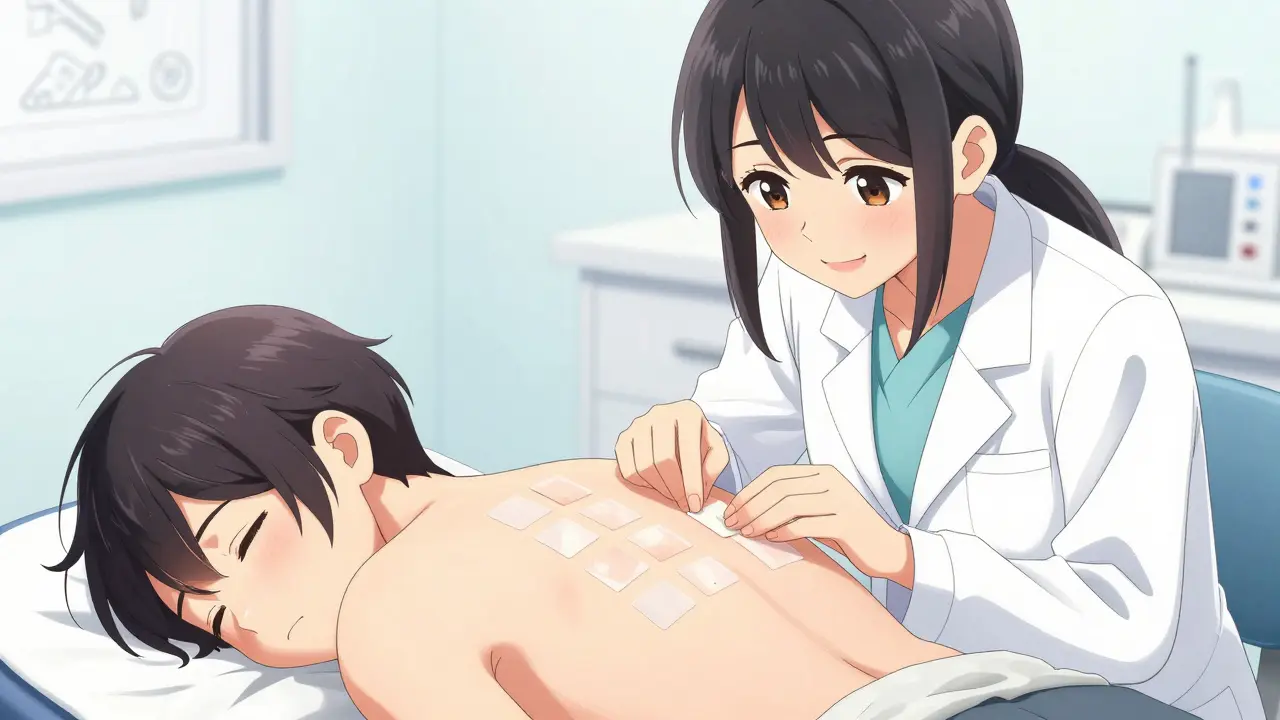
The procedure is straightforward but requires patience. A dermatologist applies small amounts of suspected allergens to your upper back using special patches. These patches stay on your skin for exactly 48 hours. During this time, you must keep the area dry and avoid sweating heavily. After two days, the patches are removed, and the doctor reads the initial results. However, the story isn’t over yet. Because these reactions are delayed, a second reading happens 24 to 48 hours later (72-96 hours after application), and sometimes a third reading occurs even later to catch late-onset reactions.
The results are graded on a standardized scale established by the International Contact Dermatitis Research Group (ICDRG):
- (−) Negative: No reaction.
- (+) Doubtful: Slight redness only.
- (++) Weak Positive: Redness, swelling, and tiny bumps.
- (+++) Strong Positive: Significant swelling and blisters.
- (++++) Extreme Reaction: Large blisters and intense inflammation.
This meticulous process ensures high specificity-studies show patch testing has a 95-98% accuracy rate when performed correctly. It’s not just about finding *an* allergen; it’s about finding the *right* one so you can stop avoiding everything and start living normally again.
Why Metals Are Common Culprits
If you’ve ever had a green mark on your finger from a ring or a rash under a watch strap, you might suspect a metal allergy. Nickel is the most frequent offender, affecting nearly 18.5% of patients tested in North America. But it’s not just jewelry. Nickel hides in coins, belt buckles, zipper pulls, eyeglass frames, and even some surgical instruments.
Cobalt and chromium are other metals frequently included in standard patch test series. Cobalt often appears alongside nickel because people allergic to one are likely allergic to the other. Chromium is commonly found in leather goods treated with tanning agents, cement, and certain hair dyes.
| Metal | Test Concentration | Common Sources |
|---|---|---|
| Nickel Sulfate | 5% in petrolatum | Jewelry, belt buckles, coins, zippers |
| Cobalt Chloride | 1% in petrolatum | Alloys, blue pigments, ceramics |
| Potassium Dichromate | 0.5% in petrolatum | Leather goods, cement, hair dyes |
Identifying a metal allergy changes how you interact with the world. Once you know nickel is your enemy, you can switch to titanium or plastic alternatives for piercings, choose stainless steel watches with protective coatings, and avoid cheap costume jewelry. For healthcare workers, knowing about nickel sensitivity can prevent chronic hand dermatitis from handling instruments.
The Hidden Danger of Fragrance Allergies
Fragrance allergies are tricky. They account for 10-12% of positive patch test reactions in North America, yet many people don’t realize their lotion, laundry detergent, or shampoo is the cause. Fragrance is a broad term that covers hundreds of individual chemicals. Manufacturers often list "fragrance" or "parfum" on labels without disclosing the specific ingredients, making it hard for consumers to avoid triggers.
To tackle this complexity, dermatologists use specialized fragrance mixes. The North American Contact Dermatitis Group (NACDG) includes two main mixes in their baseline series: Fragrance Mix I (FM I) and Fragrance Mix II (FM II). FM I contains eight common sensitizers, while FM II contains six. However, relying solely on these mixes misses about 10-15% of fragrance allergies.
This is why comprehensive testing matters. Experts recommend adding individual fragrance chemicals to the test panel. Key markers include:
- Balsam of Peru (Myroxylon pereirae): Found in vanilla-scented products and some medications.
- Cinnamic Aldehyde: Common in cinnamon-scented items.
- Linalool and Limonene: Citrus and floral scents that oxidize and become allergenic over time.
In Europe, regulations require labeling 26 specific fragrance allergens if they exceed certain concentrations (0.001% in leave-on products like creams, and 0.01% in rinse-off products like shampoos). The US FDA has proposed similar rules, but currently, labeling is voluntary. This gap makes patch testing even more critical for identifying hidden sensitizers in products labeled "unscented" or "natural," which may still contain reactive compounds.
Preparing for Your Patch Test: What to Expect
Getting a patch test isn’t like popping into a clinic for a quick check-up. It’s a three-day commitment that requires planning. Here’s what you need to know to ensure your results are accurate.
- Stop Steroid Creams: If you’re using topical steroids on your back or face, your doctor may ask you to pause them for a week or two before the test. Steroids suppress inflammation, which could lead to false-negative results.
- Keep Dry: For the first 48 hours, the patches must stay dry. No swimming, no heavy sweating, and usually no showering directly on the back. Many clinics advise against showering entirely for 72 hours to be safe.
- Dress Comfortably: Wear loose-fitting cotton shirts. Tight clothing can rub off the patches or irritate the skin, leading to false positives.
- Avoid Sun Exposure: Don’t tan or expose your back to direct sunlight during the test period, as UV light can interfere with reactions.
You’ll typically make three visits to the dermatologist’s office:
- Visit 1 (Day 1): Application of patches. Takes 30-45 minutes.
- Visit 2 (Day 3): Removal of patches and first reading. Takes 20-30 minutes.
- Visit 3 (Day 5): Final reading to catch delayed reactions. Takes 15-20 minutes.
Some patients report itching under the patches. Resist the urge to scratch or peel them off prematurely. Doing so compromises the test. If the itching becomes unbearable, call your doctor-they may advise you to come in early rather than removing the patches yourself.

Interpreting Results and Avoidance Strategies
Once the readings are complete, your dermatologist interprets the results in the context of your medical history. A positive reaction means you are sensitized to that substance, but it doesn’t always mean it’s causing your current rash. The doctor will determine clinical relevance based on your exposure levels.
For example, if you test positive to balsam of Peru but never use vanilla-scented products, that result might be less urgent than a positive nickel test if you wear multiple pieces of jewelry daily. However, cross-reactivity is real. Being allergic to one metal or fragrance component can increase your risk of reacting to others.
Successful avoidance leads to significant improvement. Studies show that 60-80% of patients achieve complete clearance of symptoms once they identify and avoid their triggers. This might involve switching to fragrance-free detergents, using barrier creams on hands, or choosing nickel-free hardware for home projects.
Reading product labels becomes a new skill. Look for terms like "fragrance-free" (not just "unscented") and check ingredient lists for specific allergens if you have known sensitivities. Apps and databases maintained by organizations like the American Contact Dermatitis Society (ACDS) can help decode complex ingredient lists.
Limitations and Future Directions
Patch testing isn’t perfect. It can only test a finite number of substances-typically 80 to 120 allergens in a comprehensive series. With tens of thousands of potential chemicals in consumer products, there’s always a chance of missing a rare sensitizer. Additionally, irritant reactions can mimic allergic ones, requiring expert interpretation to distinguish between the two.
New developments are emerging to improve accuracy. The NACDG introduced the "Fragrance 20" series in 2023, adding eight new markers to capture rising sensitization rates to compounds like citral and farnesol. Researchers are also exploring peptide-based testing for metal allergies, which could offer faster or more precise diagnostics in the future.
Despite these limitations, patch testing remains the most reliable tool available. As consumer products become more complex and "natural" marketing obscures ingredient transparency, the demand for accurate diagnosis continues to grow. Understanding your body’s triggers through patch testing empowers you to take control of your skin health.
How long does patch testing last?
The entire process spans about five days. Patches are applied on Day 1, removed and read on Day 3, and finally read again on Day 5. Each visit takes roughly 15 to 45 minutes, depending on the stage.
Can I shower during patch testing?
No, you should avoid getting the test site wet for the first 48 hours. Most dermatologists recommend avoiding showers entirely for 72 hours to prevent dislodging the patches or diluting the allergens, which could lead to inaccurate results.
Is patch testing painful?
The application itself is painless. However, if you are allergic to a substance, the reaction site may itch, burn, or blister. Mild itching is common, but severe discomfort should be reported to your doctor immediately.
What is the difference between Fragrance Mix I and II?
Fragrance Mix I contains eight common fragrance allergens, while Fragrance Mix II contains six. Together, they cover about 70-80% of fragrance allergies. Additional individual chemicals are often tested to catch the remaining cases missed by the mixes alone.
Does insurance cover patch testing?
Coverage varies by provider and plan. Many insurers cover patch testing if deemed medically necessary for chronic dermatitis. Check with your insurance company beforehand and confirm with your dermatologist’s office to understand any out-of-pocket costs.