
You might think that once you have Medicare, your prescription costs are set. The reality is far more complex. Your actual bill depends heavily on where your specific medications sit within your plan's formulary. For most people, the biggest savings come from understanding how generic drug coverage works inside these lists. If you know the rules, you can keep hundreds of dollars in your pocket every year.
In 2026, the landscape has shifted again thanks to new federal laws. The hard cap on out-of-pocket spending is now fully active, changing how much you pay for generics versus brand names. Let’s break down exactly how this system operates so you aren’t caught off guard by a surprise bill at the pharmacy counter.
What Is a Formulary and Why Does It Matter?
A formulary is simply the list of drugs your Medicare Part D plan agrees to cover. Think of it as a menu. Not every medication is on it, and those that are, have different prices depending on their placement. This structure isn't random; it’s designed by the Centers for Medicare & Medicaid Services (CMS) to encourage the use of lower-cost options.
Generic drugs are the backbone of this system. In 2023, they made up 92% of all prescriptions filled under Part D. That means almost everyone relies on them. However, just because a drug is generic doesn’t mean it’s automatically cheap or covered without restrictions. Plans organize these drugs into tiers, which directly dictate your copayment.
- Tier 1: Preferred generics. These usually have the lowest fixed copays, often between $0 and $15 for a 30-day supply.
- Tier 2: Non-preferred generics. You might pay a percentage of the cost (coinsurance) or a higher fixed fee, sometimes up to $40.
- Tiers 3-5: Brand-name and specialty drugs. These are significantly more expensive and rarely include standard generics.
The goal is clear: steer you toward Tier 1. If your doctor prescribes a generic that falls into Tier 2, you need to ask why. Often, there is a preferred alternative in Tier 1 that works just as well but costs less.
How Much Do You Actually Pay in 2026?
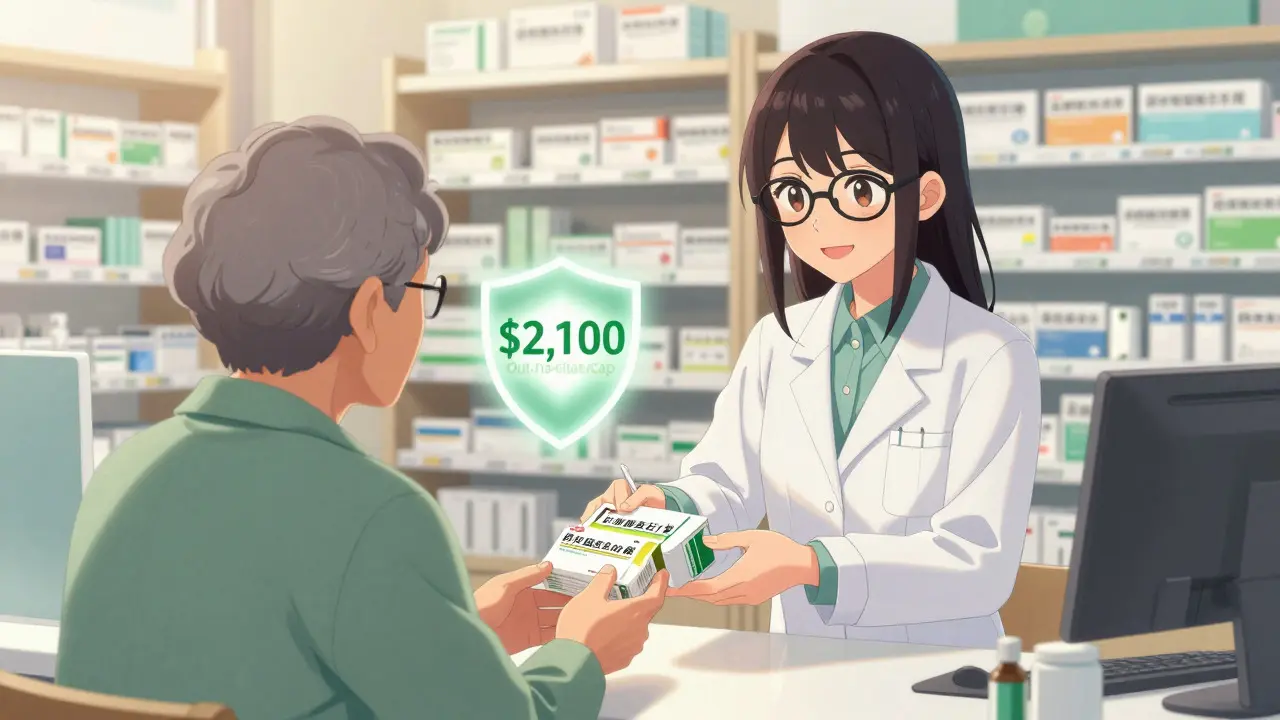
The math behind your prescription bill changed dramatically with the Inflation Reduction Act. By January 1, 2025, a hard cap on annual out-of-pocket spending was introduced. In 2026, that cap sits at $2,100. This is a game-changer for anyone taking multiple generic medications.
Here is how the payment phases work for generic drugs specifically:
- Deductible Phase: Before any coverage kicks in, you must meet your deductible. In 2025, this was $615. Check your specific plan for the 2026 amount, as it may adjust slightly. During this phase, you pay 100% of the drug cost.
- Initial Coverage Phase: Once you hit the deductible, you typically pay 25% coinsurance for generic drugs. The plan pays the rest. Every dollar you spend here counts toward your out-of-pocket maximum.
- Catastrophic Coverage: This is the big win. Once your true out-of-pocket costs reach the $2,100 threshold (in 2026), your cost-sharing drops to $0 for the rest of the calendar year. No more "donut hole" worries for generics.
It is crucial to understand what counts toward that $2,100 limit. For generic drugs, only your actual payment-what you hand over at the pharmacy-counts. For brand-name drugs, the calculation is trickier because manufacturer discounts also count. This discrepancy means hitting the cap faster is easier if you stick to generics.
| Feature | Generic Drugs (Tier 1-2) | Brand-Name Drugs (Tier 3-5) |
|---|---|---|
| Typical Copay | $0 - $40 | $40 - $100+ |
| Coinsurance Rate | 25% | 25% (but based on higher price) |
| Counts Toward Cap? | Yes, full amount paid | Yes, includes manufacturer discount |
| Catastrophic Phase Cost | $0 | $0 (for most plans) |
Rules That Protect Your Access to Generics
You might worry that a plan will exclude the generic you need to save money. Federal regulations prevent this. Under 42 CFR §423.120, every Part D plan must include at least two chemically distinct drugs in every therapeutic class. This ensures you always have options.
Furthermore, plans must cover at least 85% of drugs within each class, including generics. There are six "protected classes" of medications-such as antidepressants, antipsychotics, and immunosuppressants-where plans must cover 100% of available generics. If you take medication for mental health or organ transplants, your access is legally safeguarded.
Plans make these decisions through Pharmacy and Therapeutics (P&T) Committees. These groups consist of practicing physicians and pharmacists who review evidence to decide which generics go into Tier 1 versus Tier 2. They don't do this arbitrarily; they look at clinical effectiveness and cost data. However, if a newer generic enters the market, it might start in a higher tier until enough data proves its value. This is where communication with your doctor becomes vital.
Pitfalls to Avoid When Using Generics
Even with good intentions, beneficiaries often stumble over formulary details. Here are the most common traps:
- Therapeutic Interchange Confusion: Sometimes a pharmacist substitutes a generic that isn't on your plan's formulary. If your plan covers Generic A but not Generic B, and the pharmacist gives you B, you might get charged full price. Always verify the specific generic name on your formulary.
- Ignoring Annual Changes: Formularies change every year. A drug that was Tier 1 last year might move to Tier 2 in 2026. You must review your Annual Notice of Change (ANOC) in the fall. Data shows 37% of plans modify at least one generic's tier placement annually.
- Authorized Generics: Some brand manufacturers sell their own drugs as "authorized generics." These can be confusing because they look like brands but act like generics. They accounted for 12% of generic prescriptions in 2024. Check if your plan treats them differently.
If your needed generic isn't covered, don't just pay cash. Request a "coverage determination." According to 2023 CMS data, 83% of these requests result in approval. It takes a bit of paperwork, but it saves money.

Strategies to Minimize Your Costs
Optimizing your generic coverage requires proactive steps. First, use the Medicare Plan Finder tool during Open Enrollment. Enter your exact medication names. Research indicates that 61% of beneficiaries who use this feature save an average of $427 annually. Don't guess; check the numbers.
Second, look for plans with $0 deductibles. In 2025, 52% of stand-alone Prescription Drug Plans (PDPs) offered no deductible. If you take daily generics, avoiding the initial deductible phase can shave hundreds off your yearly total.
Third, talk to your doctor about therapeutic alternatives. If your current generic is Tier 2, ask if a Tier 1 equivalent exists. Doctors often prefer prescribing the cheapest effective option to help patients stay adherent to their regimen. Finally, utilize the new "generic price comparison tools" that plans are required to include in member portals starting in 2026. These tools highlight the lowest-cost alternatives in your therapeutic class.
Looking Ahead: What’s Changing Next?
The future of Part D generic coverage points toward even greater standardization. The Congressional Budget Office projects that generic utilization will rise to 94% by 2030. More patents are expiring, bringing cheaper options to the market.
Additionally, the Medicare Drug Price Negotiation Program will begin affecting selected generics starting in 2029. Insulin glargine (generic Lantus) is among the first drugs subject to negotiation. While this impacts brands initially, the ripple effect will pressure generic pricing structures. Analysts predict that by 2027, 95% of beneficiaries will have access to $0 copays for at least half of commonly prescribed generics. Staying informed today prepares you for these benefits tomorrow.
Does my Medicare Part D plan cover all generic drugs?
Not necessarily all, but most. Plans must cover at least 85% of drugs in each therapeutic class, including generics. For protected classes like antidepressants and immunosuppressants, they must cover 100% of available generics. Always check your specific formulary to see if your exact medication is listed.
What is the out-of-pocket cap for generics in 2026?
In 2026, the hard cap on out-of-pocket spending for Medicare Part D is $2,100. Once you spend this amount on covered drugs (including your share of premiums and copays), you enter catastrophic coverage where you pay $0 for the rest of the year.
Why is my generic drug in Tier 2 instead of Tier 1?
Tier placement depends on the plan's negotiations with manufacturers and clinical reviews. Newer generics often start in Tier 2 until sufficient usage data supports moving them to Tier 1. You can ask your doctor for a Tier 1 alternative or request an exception from your plan.
Do I have to pay the deductible for generic drugs?
Yes, unless your plan has a $0 deductible. Most plans require you to meet the annual deductible (e.g., $615 in 2025) before coverage begins. During this phase, you pay 100% of the drug cost. Choosing a plan with no deductible can save you money if you take regular medications.
What happens if my generic isn't on the formulary?
You can request a coverage determination or appeal. Your doctor can provide a statement of medical necessity. Historically, about 83% of such requests are approved. Alternatively, you can switch plans during Open Enrollment if your current plan excludes your essential medication.