
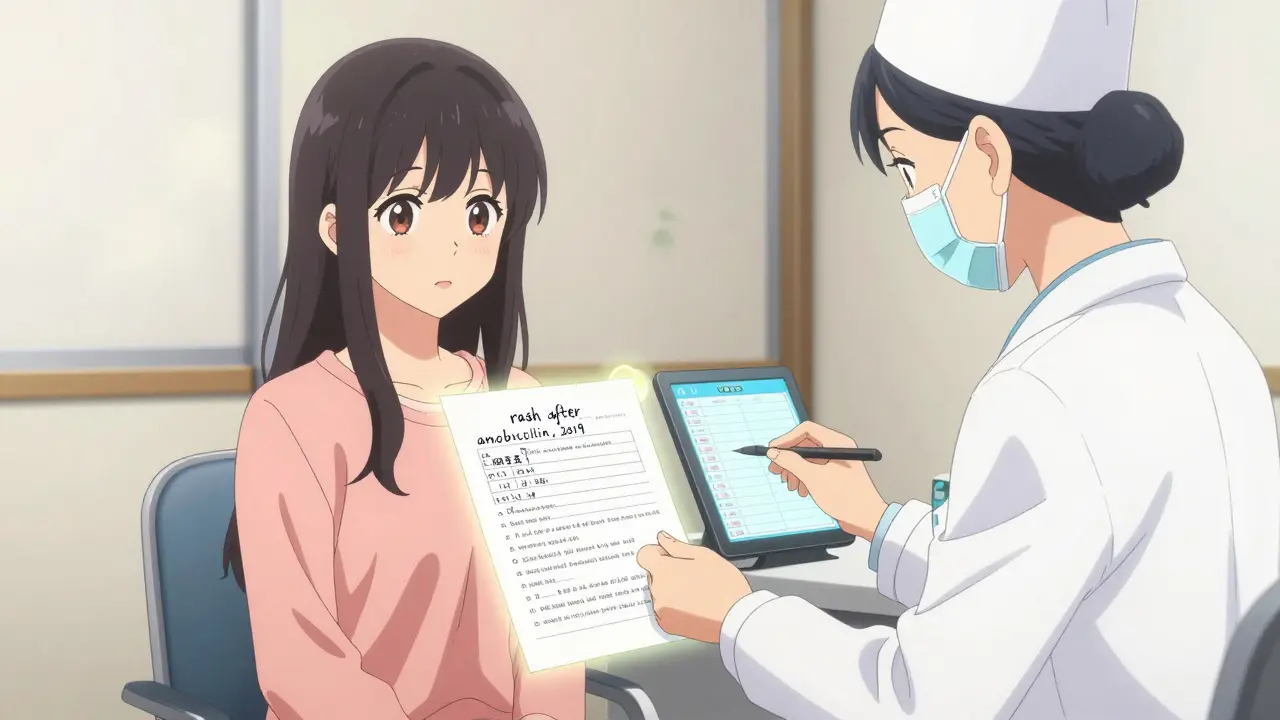
When you walk into a doctor’s office, ER, or hospital, one of the most important things they need to know isn’t your symptoms or your pain level-it’s what drugs your body reacts to. A simple note like “allergic to penicillin” might seem enough, but it’s often not. Inaccurate or vague allergy documentation leads to dangerous mistakes: wrong prescriptions, avoidable hospital stays, and even preventable deaths. The good news? You can fix this. With clear, specific, and consistent documentation, you can turn your medical records from a risk into a shield.
Why Vague Allergy Notes Are Dangerous
Most people say, “I’m allergic to penicillin,” or “I can’t take sulfa.” But those phrases are too broad. Penicillin isn’t one drug-it’s a whole family of antibiotics. If you had a rash after taking amoxicillin, that’s not the same as being allergic to cefalexin, which is a different class entirely. Same with sulfa: if you got a stomachache after taking Bactrim, you might not react to a different sulfa drug used for diabetes or arthritis. Yet, many EHR systems treat “penicillin allergy” as a blanket warning, blocking every related antibiotic-even ones that are safe.
A 2017 study in JAMA Internal Medicine found that 90-95% of people who say they’re allergic to penicillin aren’t actually allergic when tested. That means millions of patients are being denied effective, cheaper, first-line treatments because their records say “penicillin allergy” without details. And when doctors can’t use the best drug, they turn to broader-spectrum antibiotics, which increase the risk of resistant infections like C. diff.
What Your Medical Record Must Include
The federal government doesn’t leave this to chance. Medicare and Medicaid require that every patient’s record includes exact drug allergy information. Here’s what you need to make sure is documented:
- The exact generic drug name - Say “ampicillin,” not “penicillin.” Say “sulfamethoxazole,” not “sulfa.”
- The reaction you had - Was it a rash? Swelling? Trouble breathing? Nausea? Dizziness? Each tells a different story.
- The severity - Mild (hives), moderate (swelling, vomiting), or severe (anaphylaxis, low blood pressure, loss of consciousness).
- When it happened - Was it 2 hours after taking the pill? 3 days later? Timing helps doctors judge if it was truly an allergy or something else.
For example: “Rash and itching 4 hours after taking amoxicillin in 2019. No swelling, breathing issues, or hospitalization.” That’s specific. That’s useful. That saves lives.
How to Get It Right: A Step-by-Step Guide
Don’t wait for your next appointment. Take control now. Here’s how to make sure your records are accurate:
- Review your current records - Request your medical history from your primary care provider or hospital portal. Look for entries like “allergic to penicillin” or “NKDA.” If it’s vague or missing, flag it.
- Write down every drug reaction - List every medication you’ve ever taken that caused a problem. Include over-the-counter drugs like ibuprofen or naproxen. Don’t forget antibiotics, painkillers, or even vaccines.
- Describe each reaction clearly - Use plain language: “My face swelled up after taking amoxicillin.” “I broke out in hives after taking sulfa.” “I got dizzy and vomited after taking codeine.”
- Bring it to your next visit - Don’t just say it out loud. Hand your list to your doctor or nurse. Ask them to enter it into your EHR.
- Ask for confirmation - After they update it, ask: “Can you show me the entry in your system?” Make sure it includes the drug name, reaction, severity, and date.
Studies show that when patients bring their own written allergy lists to appointments, doctors change their records 61% of the time-often correcting dangerous misunderstandings.
What About “No Known Allergies”?
Even if you’ve never had a bad reaction, your record still needs to say so-clearly. Just writing “NKDA” isn’t enough. Many EHR systems require an explicit statement like: “Patient reports no history of drug allergies or adverse reactions.” If it’s missing, your record is considered incomplete. And incomplete records trigger extra warnings, delays, or even automatic holds on prescriptions.
Some patients assume, “I’ve never had a reaction, so I don’t need to say anything.” But if your record doesn’t confirm you’re allergy-free, doctors may assume you’re hiding something. That’s why “NKDA” must be documented-not assumed.
How EHR Systems Help (and Hurt)
Your doctor’s electronic health record (EHR) isn’t just a digital chart. It’s connected to decision tools that warn doctors before they prescribe. If your allergy is entered correctly-with the drug name, reaction, and severity-these tools can help doctors choose a safe alternative. But if your allergy is vague, the system might block all drugs in a class, even ones that are safe.
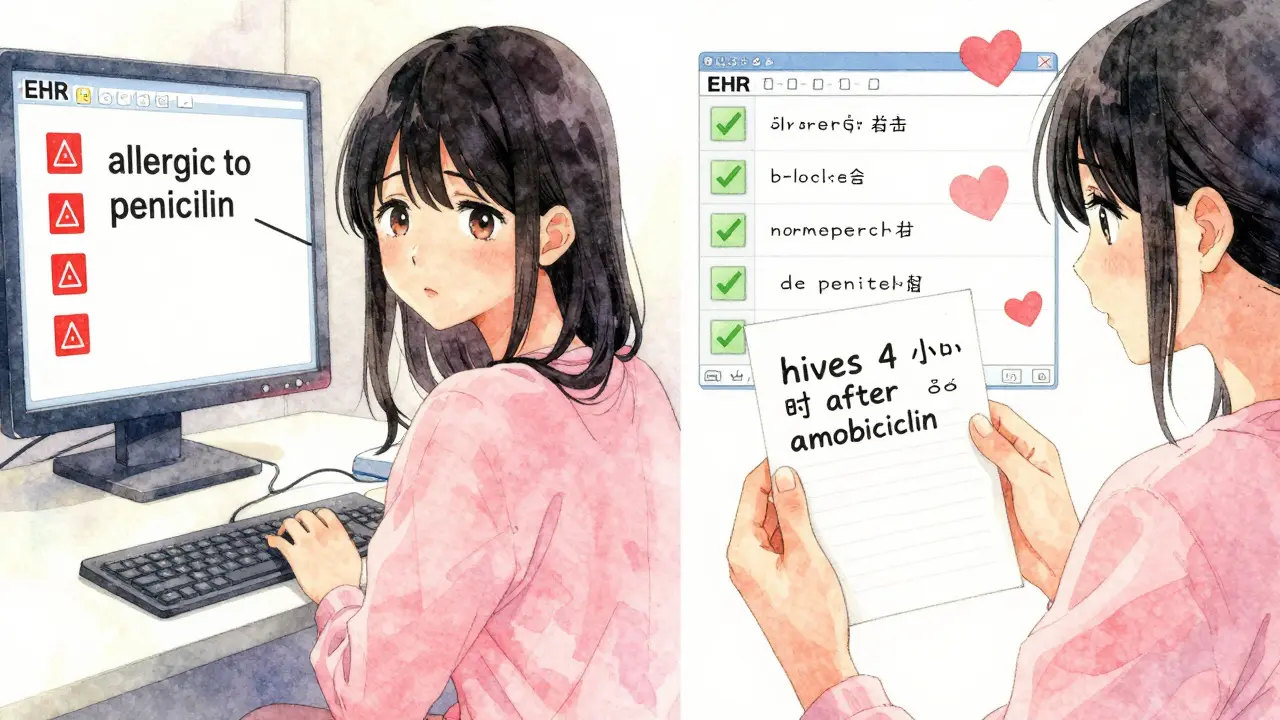
For example: If your record says “allergic to penicillin,” and you need an antibiotic for a urinary tract infection, the system might block amoxicillin, cephalexin, and aztreonam-even though only amoxicillin is in the penicillin family. That’s because the system doesn’t know the difference. But if your record says “rash after amoxicillin,” it might suggest a cephalosporin instead, which is often perfectly safe.
Modern EHRs from Epic, Cerner, and Meditech now require structured fields for allergies. That means they don’t just accept free text-they ask you to pick the drug from a list, select the reaction type, and choose severity. This isn’t bureaucracy. It’s safety.
What to Do If You’re Not Sure
Many people think they’re allergic because they had a side effect-like nausea, dizziness, or a headache. But side effects aren’t allergies. Allergies involve your immune system. They usually show up as rashes, hives, swelling, wheezing, or anaphylaxis. If you’re not sure, don’t guess.
Ask your doctor about an allergy test. Skin tests and blood tests can confirm whether you’re truly allergic to penicillin or other drugs. If you’re not allergic, getting that confirmed means you can use better, safer, cheaper drugs in the future.
One study at Massachusetts General Hospital found that after a 10-minute structured interview, 61% of patients needed changes to their allergy records. Over 200 vague entries were replaced with precise ones. That’s not just paperwork-it’s better care.
What Happens If You Don’t Document It
Missed or wrong allergy info isn’t just a clerical error. It’s a leading cause of preventable harm. According to the Institute of Medicine, poor allergy documentation contributes to 6.5% of all medication errors. That’s over 1.3 million injuries and 7,000 deaths each year in the U.S. alone.
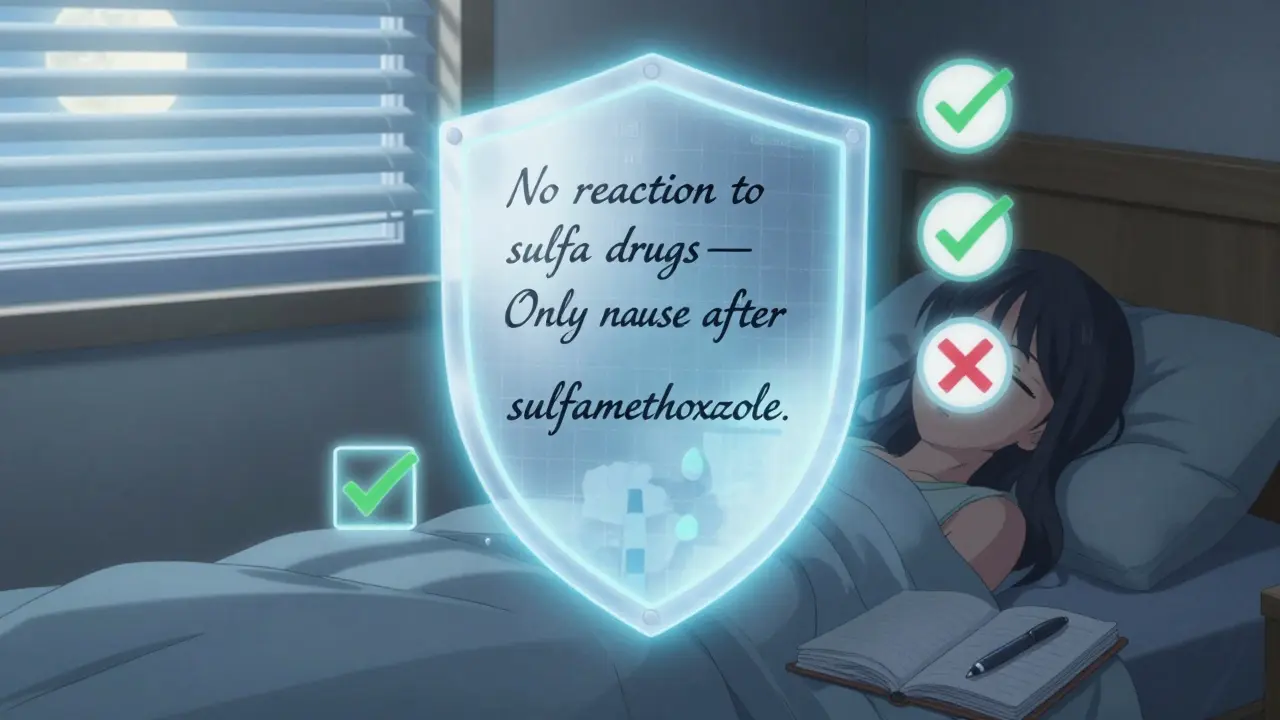
Healthcare facilities that don’t meet federal documentation standards risk losing Medicare funding. But more importantly, you risk getting the wrong drug. A patient with a documented “sulfa allergy” might be given a different sulfa drug for a bladder infection-because the doctor didn’t know the exact reaction. That’s not negligence. It’s a system failure. And it’s fixable.
Future Changes You Should Know About
By 2025, all certified EHRs will be required to give you tools to view, edit, and share your allergy list directly from your phone or computer. The FDA and ONC are pushing for patient-driven allergy updates, so you won’t have to wait for a doctor’s appointment to fix a mistake.
Soon, AI tools will scan your doctor’s notes and suggest corrections. If your chart says “allergic to penicillin” but your notes mention “rash after amoxicillin,” the system will flag it. That’s coming. But it won’t help if you don’t start now.
Final Thought: Your Record Is Your Shield
Doctors rely on your medical record to make split-second decisions. If your allergy info is vague, they’re flying blind. If it’s clear, precise, and complete, they can treat you safely and effectively. Don’t assume someone else will fix it. Don’t wait for the next visit. Take five minutes today to review your records. Write down every reaction. Be specific. Ask for confirmation. Your life could depend on it.
What if I only remember the brand name of the drug I was allergic to?
Always ask your doctor or pharmacist to translate the brand name into the generic drug name. For example, “Advil” is ibuprofen, “Tylenol” is acetaminophen, and “Bactrim” is sulfamethoxazole-trimethoprim. Generic names are used in medical records because they’re standardized across all brands. If you don’t know the generic, bring the pill bottle or packaging to your appointment.
Can I remove an allergy from my record if I outgrew it?
Yes-but only after confirmation. If you had a reaction years ago and haven’t had one since, ask for an allergy test. If it’s negative, your doctor can update your record to say “allergy ruled out” or “previously reported, now cleared.” Never just delete it yourself. Always have a provider document the change with a reason.
Do I need to update my allergies every time I see a doctor?
No. Federal rules say providers must have an up-to-date list at least once during an EHR reporting period, not at every visit. But if you’ve had a new reaction since your last visit, you should tell your provider immediately. Don’t wait for an annual checkup. New allergies can develop at any age.
What if my record says I have no allergies but I had a reaction once?
That’s a serious gap. Even one reaction counts. Tell your provider immediately and ask them to add it. A single episode of hives, swelling, or trouble breathing after a drug can mean you’re allergic. Leaving it out puts you at risk every time you’re prescribed a similar drug.
Can I access my allergy record online?
Yes. Most hospitals and clinics now offer patient portals where you can view your medical records, including allergy lists. Log in and check under “Medications,” “Allergies,” or “Health Summary.” If you can’t find it, call your provider’s office and ask how to access it. You have a legal right to this information.
Chris Bird
March 11, 2026 AT 09:43LiV Beau
March 13, 2026 AT 06:09Denise Jordan
March 14, 2026 AT 00:49Adam Kleinberg
March 14, 2026 AT 02:58Kenneth Zieden-Weber
March 15, 2026 AT 21:23Bridgette Pulliam
March 16, 2026 AT 11:04Randall Walker
March 18, 2026 AT 00:35David L. Thomas
March 19, 2026 AT 09:08Shourya Tanay
March 20, 2026 AT 11:10Mike Winter
March 21, 2026 AT 09:13Gene Forte
March 21, 2026 AT 16:03