
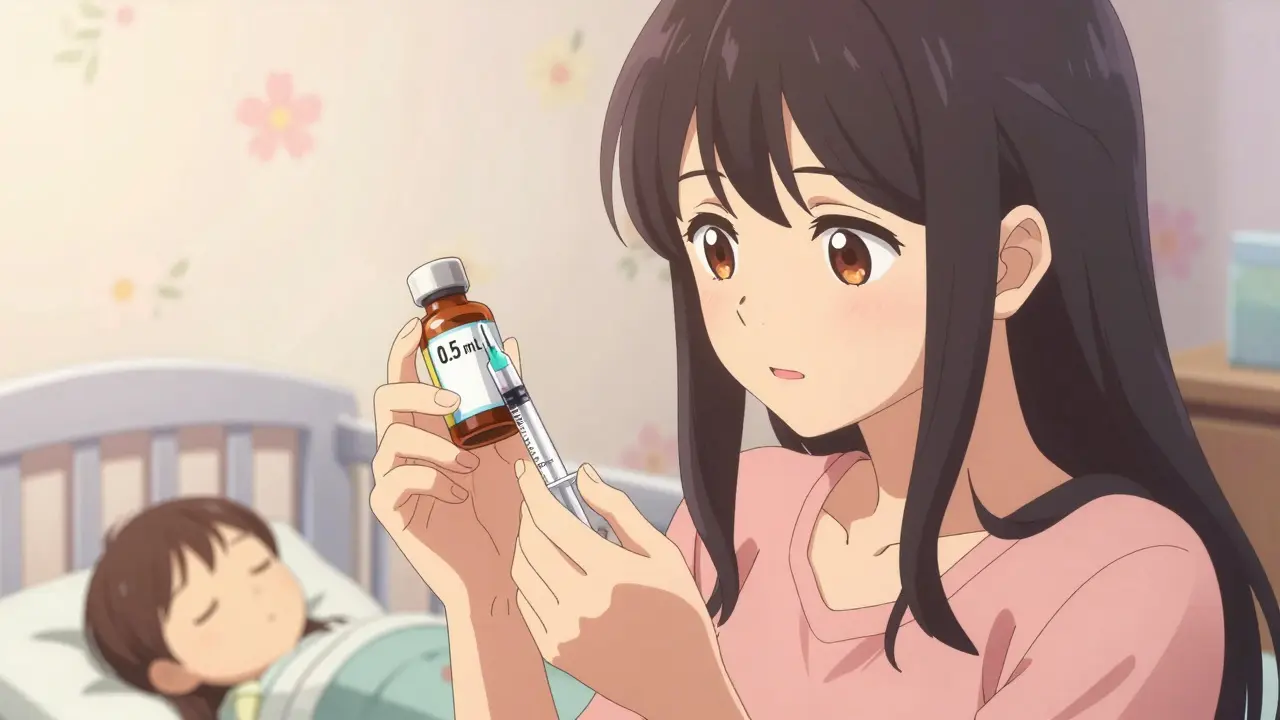
Getting the right dose of liquid medicine isn’t just about following instructions-it’s about staying safe. Every year, over a million people in the U.S. are injured because someone gave the wrong amount of liquid medication. Most of these mistakes happen because people misread the label. You’re not alone if you’ve stared at a bottle and wondered: Is that 0.5 mL or 5 mL? Is the spoon I’m using really the right size? This guide cuts through the confusion and shows you exactly how to read liquid prescription labels the right way.
What You’ll See on the Label
Every liquid medicine bottle has three key pieces of information you need to read carefully:
- Total container volume - This is how much medicine is in the whole bottle. It’s usually printed near the bottom, like “118 mL” or “240 mL.” This is not your dose. It’s just the total amount in the bottle.
- Concentration - This tells you how much medicine is in each milliliter. It looks like “125 mg per 5 mL” or “240 mg/5 mL.” This is the most important part. It means every 5 mL of liquid contains 125 mg or 240 mg of the active drug.
- Dosage instructions - This tells you how much to give. It might say “Take 10 mL twice daily” or “Give 2.5 mL every 6 hours.” This number is your actual dose.
Don’t mix up the concentration with the dose. If the label says “125 mg/5 mL” and the instruction says “Take 5 mL,” you’re giving 125 mg. But if the instruction says “Take 2.5 mL,” you’re giving half that dose-62.5 mg. Always check both numbers.
Why Milliliters (mL) Are the Only Unit You Should Trust
Look at the label. If you see “tsp” or “tbsp,” stop. That’s outdated and dangerous. The FDA and the National Council for Prescription Drug Programs (NCPDP) have required all liquid prescriptions to use milliliters (mL) since 2016. Why? Because household spoons are wildly inconsistent.
A teaspoon from your kitchen might hold anywhere from 2.5 mL to 7.5 mL. A tablespoon could be 5 mL or 20 mL. That’s a 300% difference. A 2016 study in the Journal of Pediatrics found parents using spoons were twice as likely to give the wrong dose compared to those using mL-based devices.
Proper labels only use mL. No teaspoons. No tablespoons. Just numbers followed by “mL.” That’s the law. If you see “tsp” on a new prescription, ask the pharmacist to correct it.
How to Read Numbers Correctly
Numbers on labels follow strict rules to prevent deadly mistakes.
- Always use a leading zero - Write “0.5 mL,” never “.5 mL.” A missing zero can make someone think it’s 5 mL instead of 0.5 mL. That’s a 10x overdose.
- Never use a trailing zero - Write “5 mL,” never “5.0 mL.” That extra decimal can make someone think it’s 50 mL. That’s also a 10x overdose.
- Space the number from the unit - It should say “5 mL,” not “5mL.” That small space helps your brain separate the number from the unit.
These rules aren’t suggestions. They’re backed by research from Johns Hopkins. When labels followed these formats, dosing errors dropped by 47%.
How to Use the Measuring Device
The pharmacy should give you a dosing device with the medicine. It might be a syringe, a cup, or a spoon marked in mL. Never use a kitchen spoon.
Here’s how to measure correctly:
- Look at the device. Find the line that matches your dose. If the label says “2.5 mL,” find the 2.5 mL mark.
- Place the device on a flat surface. Don’t hold it in your hand while measuring-it tilts, and you’ll get the wrong amount.
- Look at the line straight on. Don’t look from above or below. Your eye should be level with the mark.
- Fill to the line. Don’t guess. Don’t add extra.
Some devices have both mL and tsp markings. That’s okay, but always trust the mL number. The tsp marking is just there for reference. It’s not precise.
What to Do If the Label Is Confusing
It happens. You see “240 mg/5 mL” and “Take 120 mg.” You’re not sure how much to give. Don’t guess.
Ask the pharmacist: “Can you show me how much is 120 mg on this bottle?” They can walk you through the math: If 5 mL = 240 mg, then 2.5 mL = 120 mg. That’s half the concentration.
Pharmacists are trained to explain this. If they don’t offer, ask. You have the right to understand your medicine.
What If You Don’t Have the Right Measuring Tool?
If the pharmacy didn’t give you a dosing syringe or cup, go back. They’re required to provide one. If you’re in a rush and can’t wait, call the pharmacy. They’ll mail or text you a printable measuring guide.
Never use a kitchen spoon. But if you’re in an emergency and have no other option, here’s the closest conversion:
- 1 mL = 1/5 teaspoon (but don’t trust this)
- 5 mL = 1 teaspoon (still not reliable)
- 15 mL = 1 tablespoon (even less reliable)
These conversions are only for reference. They’re not safe for regular use. The only safe way is to use a device marked in mL.
Why This Matters for Kids
Children under 12 get 75% of all liquid prescriptions. Their bodies are small. A tiny mistake can be dangerous. A 2021 study found that 23% of low-income families still use household spoons because they don’t have proper tools. That’s why the American Academy of Pediatrics now recommends that doctors talk about medication safety during every well-child visit.
Parents who get a live demonstration from a pharmacist reduce their dosing errors from 39.4% to just 22%. That’s a huge difference. Ask for a demo. Even if it takes five extra minutes.
What’s Changing in 2026
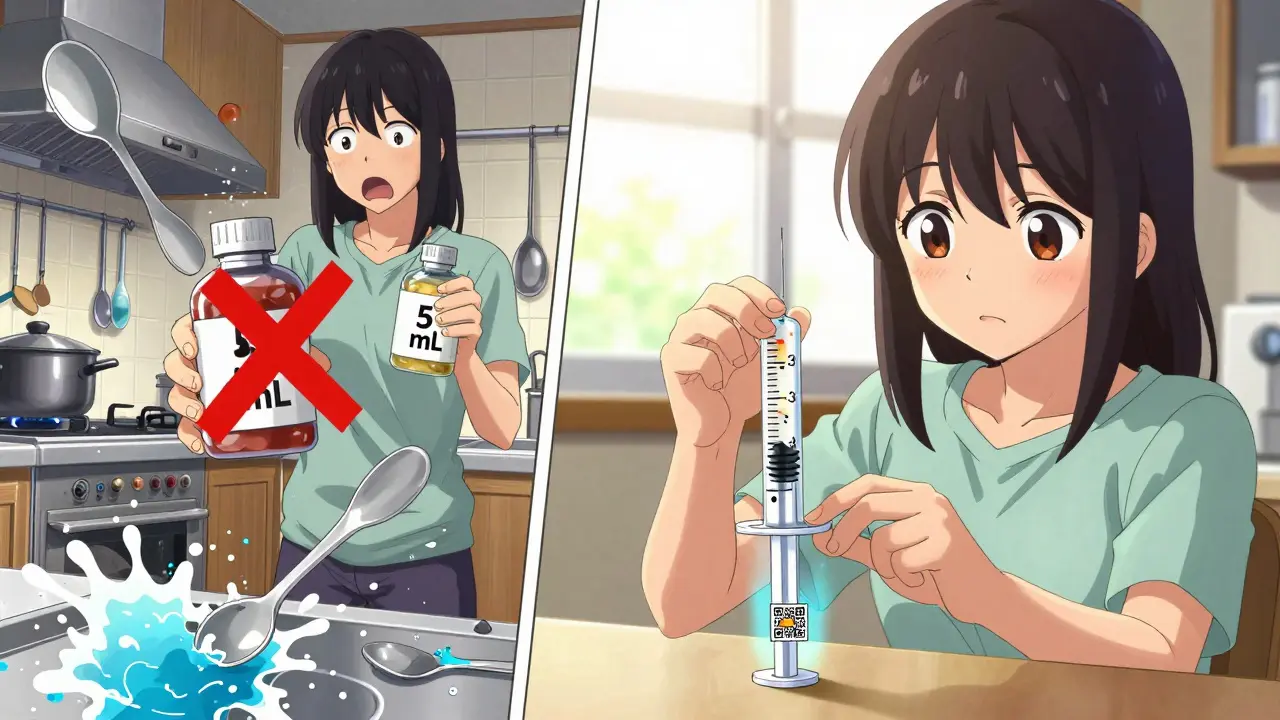
Labels are getting better. In 2023, the FDA proposed new rules requiring pictograms-simple pictures showing how to fill a syringe-on all liquid prescriptions. Early tests showed those pictures cut errors by 37%.
Some pharmacies, like Amazon Pharmacy and Medly, are adding QR codes to labels. Scan it, and you’ll see a 30-second video showing exactly how to measure the dose.
By 2026, full compliance with mL-only labeling is expected across all U.S. pharmacies. But until then, you still need to know how to read the label yourself.
What to Do After You Get the Medicine
Before you leave the pharmacy, do this:
- Ask: “What’s the dose in mL?”
- Ask: “Can you show me how to use the measuring tool?”
- Ask: “What happens if I give too much?”
- Repeat back what they told you: “So, I give 3 mL twice a day, not 3 teaspoons, right?”
This is called the “teach-back” method. Studies show it cuts errors by 63%. It’s simple. It works.
Final Reminder
Medication errors are preventable. You don’t need to be a doctor or a nurse to read a label. You just need to know what to look for:
- Only trust mL-not teaspoons or tablespoons.
- Check the concentration: “X mg per 5 mL.”
- Match your dose to the mL number, not the mg number.
- Use the device that came with the medicine.
- Ask questions. Always.
One wrong dose can make a child sick. One right dose can help them feel better. You have the power to get it right.
Can I use a kitchen spoon if I don’t have the measuring cup?
No. Kitchen spoons vary too much in size. A teaspoon can hold anywhere from 2.5 mL to 7.5 mL. That’s a dangerous range. Always use the device provided by the pharmacy. If you lost it, call them for a replacement. They’re required to give you one.
What does “125 mg/5 mL” mean on the label?
It means every 5 milliliters of liquid contains 125 milligrams of the medicine. If your dose is 2.5 mL, you’re getting half that amount-62.5 mg. If your dose is 10 mL, you’re getting 250 mg. Always match your dose in mL to the amount on the label, not the mg number.
Why do some labels say “0.5 mL” and others say “.5 mL”?
Only “0.5 mL” is correct. The leading zero prevents mistakes. If you see “.5 mL,” it’s outdated or poorly printed. That small missing zero can lead someone to think it’s 5 mL instead of 0.5 mL-a 10x overdose. Report it to the pharmacy immediately.
Is it okay to use a syringe instead of a cup?
Yes. In fact, syringes are more accurate than cups, especially for small doses under 5 mL. They let you see the exact line and control the flow. Many parents prefer them for babies and toddlers. Just make sure the syringe is marked in mL, not teaspoons.
What if the label and the dose instructions don’t match?
Don’t give the medicine. Call the pharmacy or your doctor right away. Mistakes happen. Maybe the label was printed wrong, or the prescription was changed. Never guess. Always confirm. A quick phone call can prevent a serious error.
Are there apps or tools to help me measure correctly?
Yes. Some pharmacies, like Amazon Pharmacy and Medly, include QR codes on labels that link to short videos showing how to measure. You can also download free dosing apps from the American Academy of Pediatrics or the FDA. But nothing replaces a live demonstration from your pharmacist. Always ask for one.
Eric Gebeke
January 17, 2026 AT 09:24Let me just say this: if you’re still using a kitchen spoon, you’re not just careless-you’re a walking liability. I’ve seen parents give their kids 10x the dose because they thought a ‘teaspoon’ meant what they used for coffee. It’s not just ignorance-it’s negligence. The FDA has been screaming about mL-only labeling since 2016, and yet here we are. Someone’s kid is going to end up in the ER because someone ‘didn’t have the right tool.’ And then they’ll cry about how hard parenting is. Wake up.
Chuck Dickson
January 19, 2026 AT 07:08You’re absolutely right to highlight this-medication safety isn’t optional, it’s survival. I used to think I could wing it with spoons until my niece had a reaction because her grandma ‘guessed’ the dose. Now I carry a little oral syringe in my bag everywhere. Seriously. It’s the size of a pen. Costs $2. Pharmacists give them out for free if you ask. Don’t wait for a crisis to change your habits. You’ve got this.
Naomi Keyes
January 20, 2026 AT 16:34Wait-so you’re saying that if you see ‘.5 mL’ on a label, you should immediately report it? And that ‘5.0 mL’ is dangerous? And that spacing matters? And that the pharmacy is legally obligated to provide a measuring device? And that if they don’t, you should call them back? And that parents should demand a live demo? And that the AAP recommends this during every well-child visit? And that QR codes are now being implemented? And that the FDA is mandating pictograms by 2026? And that this isn’t just advice-it’s policy? And that you’re not being ‘overly cautious’-you’re being legally and medically responsible? Then why is this still even a conversation?!
Dayanara Villafuerte
January 22, 2026 AT 12:45Y’all. I just gave my 18-month-old Tylenol using the syringe the pharmacy gave me. 😌 I used to use a spoon because ‘it’s fine, right?’ Nope. Now I have a little sticker on my fridge that says ‘mL OR BUST.’ 🚫🥄 And guess what? My kid hasn’t thrown up in 3 months. 🙌 If you’re still using a spoon, you’re not saving time-you’re risking a hospital trip. Go get that syringe. I’ll wait. 🏥❤️
Jodi Harding
January 22, 2026 AT 19:10Tyler Myers
January 22, 2026 AT 21:33Let’s be real-this whole ‘mL-only’ thing is just the government’s way of controlling parents. Who says a teaspoon can’t be trusted? Maybe the ‘proper’ syringes are just part of a Big Pharma scheme to sell you more devices. I’ve been using my coffee spoon for 12 years. My kids are fine. The real danger is trusting strangers with your parenting. The FDA doesn’t know your child. You do.
Wendy Claughton
January 24, 2026 AT 09:06I just wanted to say thank you for writing this. I’m a single mom working two jobs, and I’ve been terrified of giving the wrong dose. I didn’t know about the leading zero rule or the spacing thing. I thought ‘0.5’ and ‘.5’ were the same. I cried reading this. I’m going to the pharmacy tomorrow and asking for a demo. I’m not ashamed to ask. My son deserves to be safe. Thank you for making me feel less alone.
Selina Warren
January 25, 2026 AT 01:12People still use spoons? I’m not mad-I’m disappointed. This isn’t 1998. We have smartphones, smart fridges, and smart pills. But we still trust a spoon that might hold 2.5 mL or 7.5 mL? That’s not carelessness. That’s a failure of basic education. If your child’s life depends on a measuring tool, why are you still gambling with kitchenware? Get the syringe. Use the QR code. Ask the pharmacist. This isn’t complicated. It’s survival.
Robert Davis
January 25, 2026 AT 04:52Look. I get it. You’re trying to help. But let’s be honest-this guide is just another example of over-medicalization. Parents used to raise kids with vinegar, honey, and intuition. Now we need QR codes and FDA-approved syringes just to give cough medicine? What’s next? A biometric wristband that monitors dosage in real time? This isn’t safety-it’s paranoia dressed up as science. I’ll take my spoon and my common sense any day.
Jake Moore
January 26, 2026 AT 20:21Biggest tip I’ve ever learned: always read the concentration first. I once gave my daughter 10 mL thinking it was the dose, but the label said ‘125 mg per 5 mL’-so 10 mL meant 250 mg. She was fine, but I panicked for three hours. Now I always ask: ‘What’s the concentration?’ then ‘What’s my dose in mL?’ If you can’t answer those two questions, don’t give it. Simple.
Joni O
January 27, 2026 AT 23:51i just wanted to say thank u for this. i never knew about the leading zero thing and i’ve been writing .5 ml for years 😭 i went to the pharmacy today and they gave me a free syringe and even showed me how to hold it level. i feel so much better. i’m gonna print this out and tape it to the fridge. also… i think i cried a little. sorry. 🥲
Nishant Sonuley
January 29, 2026 AT 17:02As someone from India, I can tell you this isn’t just an American problem. In my home country, people use teaspoons, medicine cups from old bottles, and even droppers from eye drops. I once saw a mother give her child a full tablespoon of antibiotics because the label said ‘1 tsp’-and she didn’t know mL existed. This guide is universal. The language changes, but the danger doesn’t. Please share this with anyone you know who gives liquid medicine. It’s not just helpful-it’s lifesaving.
Emma #########
January 31, 2026 AT 16:30I work in a pediatric clinic, and I’ve seen too many cases where a parent didn’t understand the difference between concentration and dose. I always show them the math: ‘If 5 mL = 125 mg, then 2.5 mL = 62.5 mg.’ It’s not rocket science. But they’re scared. They’re tired. They’re overwhelmed. This guide doesn’t just teach measurement-it teaches confidence. Thank you for writing it with compassion.
Andrew McLarren
February 2, 2026 AT 07:45While the intent of this document is commendable, one must consider the epistemological implications of relying on institutional authority for everyday medical decisions. The standardization of milliliter notation, while ostensibly beneficial, may inadvertently erode the autonomy of the lay caregiver by pathologizing intuitive judgment. Furthermore, the institutional mandate to use only manufacturer-provided devices may constitute a form of technocratic overreach, wherein the human element of caregiving is subordinated to bureaucratic protocol. One must ask: Are we securing safety-or constructing a regime of compliance?
Andrew Short
February 2, 2026 AT 17:06Let’s cut through the fluff. This isn’t about safety-it’s about control. Why do you think they banned ‘tsp’? Because they want you dependent on their devices. Because they want to sell you syringes. Because they want you to feel stupid if you don’t follow their rules. And now they’re adding QR codes? That’s surveillance. That’s tracking. That’s not medicine. That’s a data harvest disguised as care. Don’t be fooled. The real danger isn’t a spoon. It’s trusting them.