

Every year, thousands of people face serious health issues simply because their daily pills weren't taken correctly. It sounds manageable until you realize how easy it is to miss a dose or mix up times when juggling multiple prescriptions. If you are supporting a loved one at home, you hold the key to preventing those mistakes. Many families don't know exactly how to start, leading to confusion and stress. Fortunately, clear methods exist to turn medication management from a chaotic burden into a routine part of daily life.
We often assume doctors handle everything, but the most critical moments happen in the kitchen, not the clinic. Recent data indicates that nearly 48 million family caregivers manage medications for someone else, and over 80% of them handle some part of the process directly. When done right, this support saves lives. In fact, proper adherence prevents roughly 125,000 avoidable deaths annually in places like the United States alone. By stepping in effectively, you become a vital part of the medical team.
Key Takeaways
- Start with a master list: Keep a updated document listing every drug, dosage, and purpose to show all providers.
- Use tools early: Organizers and apps significantly lower the risk of missed or wrong doses.
- Partner with pharmacists: They are accessible experts who can explain timing and interactions.
- Watch for transitions: Hospital discharge periods carry the highest risk for medication errors.
- Protect yourself: Caregiver burnout undermines the entire system, so schedule breaks.
Understanding Your Role in Medication Support
Being a caregiver doesn't mean you must be a nurse, but it does mean being organized. Medication Adherence is the extent to which a patient takes medicines correctly as prescribed by their doctor. This concept goes beyond simply swallowing a pill on time; it involves understanding why the medicine exists, when to take it, and what happens if you forget. Families often struggle because medical instructions get lost between hospital visits and home routines.
The goal is safety. Studies show that half of all medication errors happen at home. This isn't always negligence; sometimes it is just too many pills on the table. When a patient takes five or more drugs, which is common among older adults, the math gets complicated fast. You help simplify that complexity. Think of yourself as the bridge between the hospital's prescription pad and the person sitting at home needing help.
Building the Master Medication List
This is the first and most important step. Without a central record, you cannot track changes effectively. Experts recommend creating a document that includes specific details for every single drug. It's not enough to write "Blood Pressure Med." You need the generic name, the brand name if there is one, the exact strength, and the instructions. For example, instead of writing "Take once," write "Take 1 tablet at 8 AM with food."
| Data Point | Why It Matters |
|---|---|
| Drug Name (Brand & Generic) | Ensures consistency across pharmacies and doctors. |
| Dosage Strength | Prevents accidental overdose or underdose. |
| Schedule & Timing | Clarifies frequency relative to meals or sleep. |
| Purpose of Drug | Helps the caregiver explain the importance to the patient. |
| Prescriber Contact Info | Allows quick verification if questions arise. |
Keep this list updated immediately after any visit to a specialist. Research suggests that updating your list within 24 hours of a change reduces errors significantly. Imagine a scenario where a heart doctor adds a diuretic, but the primary GP doesn't know. If the GP prescribes an arthritis painkiller that depletes potassium, the combination could be dangerous. That information gap closes when you bring the list to every appointment.
Tools and Technology for Daily Support
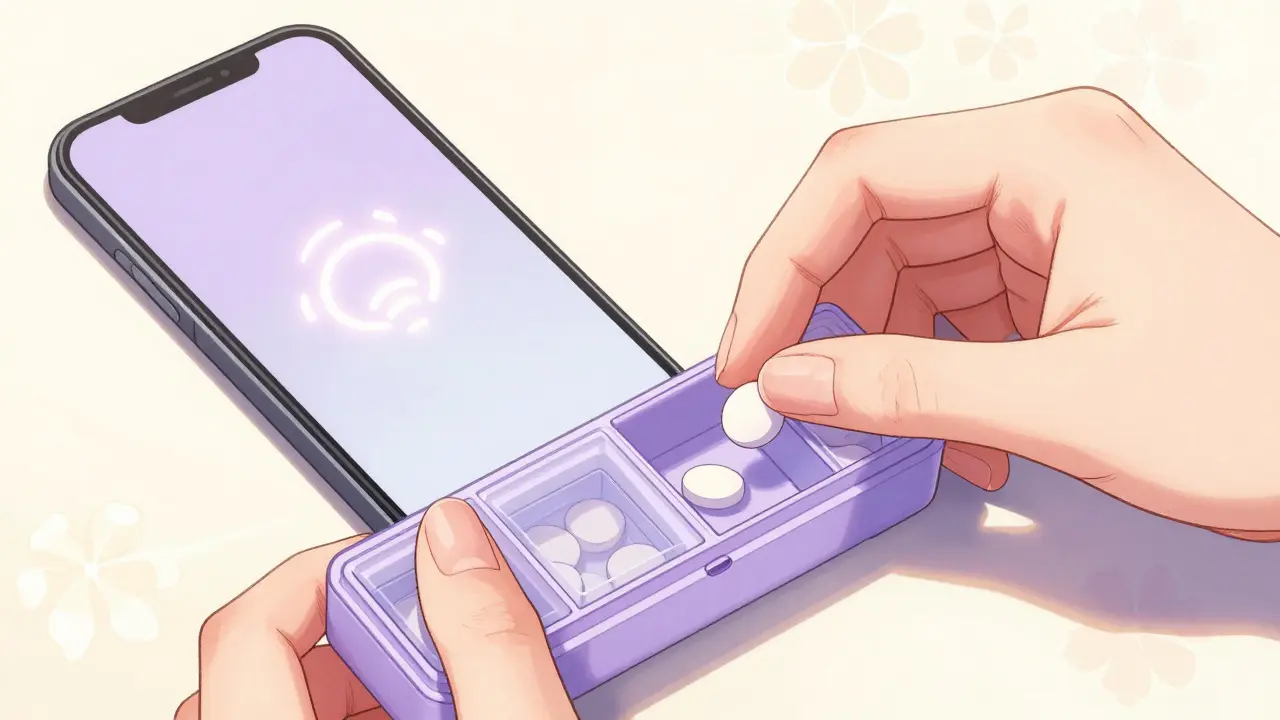
Relying on memory is risky. Even reliable people forget during stressful days. Physical tools work well for hands-on organization. A weekly pill organizer with compartments for morning and night is a classic choice. Evidence shows that simple 7-day boxes can cut down on mistakes considerably compared to scattering bottles across a counter. Some patients prefer electronic versions that beep to remind them.
Electronic Dispensers are smart devices that lock pills until a set time and sound an alarm when a dose is due. These machines have been tested in clinical settings and proved to drop missed doses significantly. They might cost more upfront, but they offer peace of mind if you aren't home every morning to supervise.
Apps have also evolved beyond simple alarms. Modern solutions send notifications to your phone if a dose isn't logged. There are voice assistants that can answer questions like, "Did Mom take her morning blood pressure pill?" This technology helps coordinate care even when you are at work. The goal is redundancy. If the pill box fails, the app alerts you.
Working with Healthcare Professionals
You should never guess when you are unsure. Pharmacists are right there to help. They are often more accessible than physicians and spend less time per patient. In many regions, over 90 percent of pharmacies allow consultations without booking ahead. Use them.
When you pick up a refill, ask four specific questions. First, when should this be taken relative to meals? Second, are there foods or other drugs that mess with this one? Third, what happens if we forget a dose today? Fourth, when should we expect results? Writing these answers down ensures you aren't overwhelmed later. Some health plans offer a service called Medication Therapy Management, where a pharmacist reviews all prescriptions together to find conflicts. If you are managing multiple chronic conditions, this meeting is crucial.

Navigating Transitions of Care
The period immediately following a hospital stay is high-risk. Statistics indicate that nearly half of medication errors occur when moving from hospital to home. The doctors there change prescriptions frequently to stabilize acute issues. Before leaving, insist on a clear discharge plan regarding meds. Ask to see the new bottles and match them to your master list.
Common pitfalls involve duplicates. Sometimes a hospital stops a heartburn medication, but the home supply continues refilling automatically. Or they start a new antibiotic that shouldn't be mixed with something the doctor already prescribed long ago. Double-check the pharmacy count. Ensure you understand exactly which old meds to stop and which to keep. Taking notes during the doctor's explanation is helpful, as memory fades quickly after leaving a hospital room.
Avoiding Burnout and Managing Stress
Caring for another person's health is exhausting. Over 40 percent of caregivers report medication tasks as their most stressful responsibility. If you are stressed, you make more mistakes, and if you make mistakes, the patient's health worsens. It becomes a cycle.
Treat caregiving like a job with boundaries. You don't have to monitor every minute of the day if systems are in place. Rotating duties with other family members works well. For instance, one sibling handles mornings while another handles evenings. This keeps everyone fresh. Also, recognize signs of caregiver fatigue. If you feel constantly anxious about forgetting doses, it's time to adjust your routine or seek professional respite care.
Frequently Asked Questions
What is the best way to track multiple medications?
Create a master list document that stays with the patient. Update it after every appointment. Include drug names, dosages, and schedules. Use a binder or digital app to keep it accessible.
Can caregivers legally give medication?
Yes, family members can assist with administration in most private home settings. However, laws vary by location. Always follow local regulations and consult the prescribing provider about restrictions.
What should I do if a dose is missed?
Check the medication leaflet for specific advice. Generally, do not double up. If the next dose is near, skip the missed one. Call the pharmacist if unsure, especially for insulin or heart drugs.
How often should we review the medication list?
Review the list every quarter for complex regimens. Immediately review whenever a new doctor visit occurs or a new symptom appears that requires a new prescription.
Is it safe to use pill organizers?
Yes, they reduce errors. Fill them only by someone responsible. Label the containers clearly with dates and names to prevent mix-ups.
Calvin H
March 31, 2026 AT 01:33Sure let's just turn everyone into a pharmacist overnight because obviously doctors can't handle their own patients anymore in this broken system
RONALD FOWLER
April 1, 2026 AT 02:26I know it feels overwhelming but people really do want to help each other get through tough times honestly
Katie Riston
April 3, 2026 AT 01:25The concept of caregiving extends far beyond mere administrative tasks. It touches the core of human dependency. We see medicine not as a tool but as a lifeline. Families are the primary safety net now. Doctors are distant figures in comparison. The burden falls on those who sleep next to the patient. You cannot automate genuine concern effectively. Lists help organize the chaos of life. Technology supports the human hand mostly. Pharmacists are the guardians of safety actually. They know the chemicals better than anyone else. Burnout happens when boundaries disappear. Stress management is part of the therapy plan. We forget to protect the protector entirely. Society relies on this hidden labor force constantly.
Christopher Curcio
April 4, 2026 AT 18:48Polypharmacy risks require strict clinical oversight protocols for adherence rates to remain optimal. Therapeutic windows narrow significantly with age and comorbidities. Pharmacokinetics dictate timing precision for maximum efficacy.
Beccy Smart
April 5, 2026 AT 05:41We have a moral duty to help our loved ones 🙏 Ignoring signs of trouble is selfish ❌ Love heals and organization saves lives 💖 Please listen to your elders ✨
Carolyn Kask
April 5, 2026 AT 15:01In this country we take responsibility seriously unlike places where people expect government bailouts for basic health needs. Americans don't need hand holding to manage household affairs properly.
Angel Ahumada
April 5, 2026 AT 16:31you think the elite understand this dynamic without context which is why i am saying nothing works for normal people unless forced to change habits first
Debbie Fradin
April 7, 2026 AT 09:14You need to stop ignoring the facts presented in front of you today. Failure to act results in preventable tragedy every single day. Optimism requires action not just hope alone.
William Rhodes
April 9, 2026 AT 06:13Keep pushing forward and believe in the system because positive outcomes wait for the persistent mind always
Vikash Ranjan
April 10, 2026 AT 12:09The economic implication of this advice remains completely unaddressed throughout the text.