

After beating hepatitis C with direct-acting antivirals (DAAs), many people think they’re done. But for those still exposed to the virus-especially people who inject drugs-HCV reinfection is real, and it’s happening more often than you’d expect. The good news? You can be cured again. And again. And again. There’s no limit. No stigma. No waiting. Just treatment, no questions asked.
How HCV Comes Back After Cure
Hepatitis C doesn’t stick around forever after treatment. More than 95% of people who finish an 8- to 12-week course of DAAs like glecaprevir/pibrentasvir (Mavyret) or sofosbuvir/velpatasvir (Epclusa) are cured. That’s called sustained virologic response at 12 weeks (SVR12). The virus is gone. Liver damage stops. Cancer risk drops. But if you’re still injecting drugs, sharing needles, or having unprotected sex with someone who has HCV, you can catch it again. Reinfection isn’t rare. In some high-risk groups, up to 1 in 5 people get HCV a second time within two years. The first six months after cure are the riskiest. That’s when your body hasn’t built up any lasting immunity. You’re just as vulnerable as you were before. Studies like the HERO trial show that younger people under 30, those still using methamphetamine, and people who inject drugs regularly are three times more likely to get reinfected. It’s not about willpower. It’s about exposure. And if you’re in a community where HCV is circulating, you’re at risk-even if you’ve been cured before.Can You Be Cured Again? Yes. Easily.
Some clinics still refuse to treat people who’ve been cured before, saying, “You should’ve stayed clean.” That’s outdated. That’s harmful. And it’s not what the science says. The CDC, WHO, and major liver societies all agree: treat HCV every time it shows up. No exceptions. No waiting. No judgment. For reinfection, the standard is still 8 weeks of glecaprevir/pibrentasvir. Same as the first time. Cure rates stay above 95%. No extra drugs. No longer treatment. No resistance issues. It works just as well as the first cure. If you relapsed after your first treatment-meaning the virus came back after you finished-you might need a different combo. That’s where sofosbuvir/velpatasvir/voxilaprevir (Vosevi) for 12 weeks comes in. It’s used when the virus didn’t fully clear the first time, not when you got it again from outside. And here’s the kicker: even if you failed a 4-week treatment, you can still be cured with the full 8-week course. The PURGE-C trial proved it. People who didn’t clear the virus with a short course didn’t develop resistance. They just needed more time. That’s huge. It means we don’t have to give up on people who miss the mark the first time.Why Shorter Treatments Are Changing the Game
For years, treatment meant 12 weeks of pills. Now, we’re seeing that 8 weeks works for most. And for people with early infection-someone who just got HCV in the last 6 months-8 weeks might be overkill. The FDA just approved Mavyret for acute HCV in June 2025. That’s the first time any DAA has been officially labeled for early infection. In the PURGE-C trial, 84% of people with new HCV infections were cured with just 4 weeks of glecaprevir/pibrentasvir. That’s not 95%, but it’s close. And for someone who can’t come back for a 12-week refill, 4 weeks is life-changing. The NIH is already testing 2-week courses in the PURGE-2 trial. If that works, we could be looking at a single weekend of pills for early HCV. Imagine that. Walk into a clinic on Monday, get tested, start treatment, and be done by Friday. No follow-up needed. No stigma. No barriers.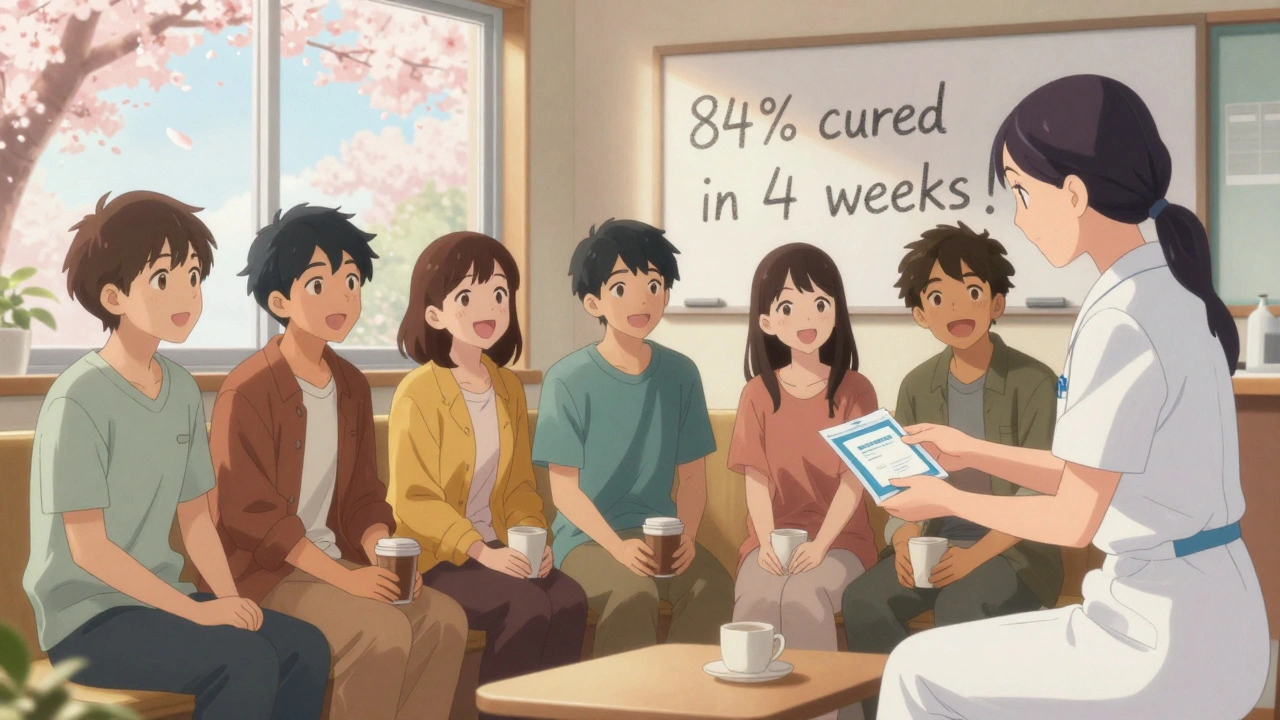
Harm Reduction Isn’t Optional-It’s Essential
You can’t cure your way out of HCV without fixing the systems that spread it. Needle exchanges aren’t just “nice to have.” They’re the single most effective tool to stop transmission. Studies show that when programs give out 200 or more clean needles per person per year, HCV infections drop by 54%. That’s not a guess. That’s data. Methadone and buprenorphine do the same thing. People on opioid agonist therapy cut their risk of catching HCV in half. That’s not because they stop using drugs. It’s because they stop sharing needles. They stop risking their liver for a fix. And here’s the truth: most people who get reinfection aren’t being offered these services. A 2024 survey of 1,200 people who inject drugs across 15 U.S. cities found 68% were denied HCV treatment because they were still using drugs. That’s not just wrong. It’s deadly. The best results come when HCV care is right next to addiction treatment. In Boston, clinics that co-locate hepatitis C treatment with methadone programs saw 82% of patients stick with their treatment. Why? Because they didn’t have to go to three different places. They didn’t have to face judgment twice. They got care where they already were.What You Need to Do After Cure
If you’ve been cured, here’s what you need to do next:- Get tested for HCV RNA every 3 months for the first 6 months. That’s when reinfection is most likely.
- Use clean needles every time. If you can’t, use bleach or a new syringe. Never reuse.
- Ask for opioid agonist therapy if you use opioids. It cuts your risk in half.
- Get vaccinated for hepatitis A and B. They don’t protect against HCV, but they protect your liver.
- Know your rights. You can be treated as many times as needed. No clinic can legally refuse you.

What’s Holding Us Back?
We have the tools. We have the drugs. We have the data. But only 38% of countries offer needle exchanges at the level the WHO recommends. In the U.S., only 32 states allow same-day HCV treatment for people who inject drugs. The rest still make you prove you’re “ready.” And the cost? It’s still a problem. In the U.S., a full course of treatment can cost up to $60,000. But Medicare and Medicaid are covering more of it now. Generic versions are coming. In places like Egypt and Pakistan, treatment costs less than $50. We can do better. The real barrier isn’t medicine. It’s stigma. It’s bureaucracy. It’s the idea that people who use drugs don’t deserve to live.What’s Next?
By 2030, the WHO wants to cut HCV infections by 90%. We can do it. But only if we treat people when they need it-not when we think they’re worthy of it. We need clinics that offer treatment on the same day as testing. We need pharmacies that hand out pills without asking for proof of sobriety. We need police and social workers to refer people to care, not arrest them. And we need to stop calling reinfection a failure. It’s not. It’s a signal. A signal that we haven’t done enough to protect people. The cure isn’t just in a pill. It’s in a clean needle. In a kind doctor. In a system that says, “We’re here for you, no matter what.”Can you get hepatitis C again after being cured?
Yes. Being cured of hepatitis C doesn’t give you lifelong immunity. If you’re still exposed to the virus-through sharing needles, unsterile tattoos, or unprotected sex-you can get infected again. Reinfection rates are highest in the first 6 months after cure, especially among people who inject drugs.
Is retreatment for HCV reinfection as effective as the first treatment?
Yes. Studies show retreatment with direct-acting antivirals (DAAs) like glecaprevir/pibrentasvir is just as effective as the first treatment, with cure rates over 95%. Reinfection doesn’t make the virus harder to treat. You don’t need special drugs or longer courses unless you had a prior treatment failure.
Why do some clinics refuse to treat people who have been cured before?
Some clinics still hold outdated beliefs that people who use drugs don’t deserve treatment or will “waste” resources. But CDC and WHO guidelines say to treat HCV every time it’s detected, regardless of past infection or current drug use. Refusing treatment based on stigma is not only unethical-it’s medically wrong.
What’s the shortest HCV treatment available now?
As of 2025, the shortest approved treatment is 8 weeks for chronic HCV. For early (acute) infection, 4 weeks of glecaprevir/pibrentasvir has been shown to cure 84% of cases, and the FDA has approved this regimen for acute HCV. Trials are now testing 2-week courses, which could become standard if results hold.
How can harm reduction reduce HCV reinfection?
Harm reduction tools like needle exchange programs and opioid agonist therapy (methadone or buprenorphine) cut HCV transmission by 50% or more. When people have access to clean needles and support services, they’re less likely to share equipment. Combining treatment with these services leads to better outcomes than treatment alone.
Should I get tested for HCV after being cured?
Yes. If you’re at risk-especially if you inject drugs, have multiple sexual partners, or are in prison-get tested every 3 months for the first 6 months after cure. After that, test at least once a year. Early detection means early treatment, and that stops the virus from spreading.
Is HCV treatment covered by insurance?
In the U.S., Medicaid, Medicare, and most private insurers cover HCV treatment, even for people who use drugs. Generic versions are now available for under $1,000 per course in some states. If you’re denied coverage, ask for a patient assistance program-many drugmakers offer free treatment to those who qualify.
Matt Dean
December 1, 2025 AT 17:49Let me get this straight - you’re telling me we should just hand out pills like candy to people who keep sticking needles in their arms? Cool. So now we’re rewarding bad choices with free medicine? What’s next? Free liver transplants for smokers?
There’s a difference between compassion and enabling. This isn’t healthcare - it’s a surrender.
Walker Alvey
December 3, 2025 AT 06:53Oh wow. Another saint in a white coat preaching to the lost. The virus doesn’t care about your ethics. It just multiplies. And you? You just keep writing blog posts like it’s a TED Talk.
Meanwhile, the real problem isn’t stigma - it’s that nobody’s teaching people how to not be dumb. But sure, let’s treat them again. And again. And again. Until their liver turns to dust. Progress.
Bee Floyd
December 5, 2025 AT 05:01I’ve worked in harm reduction for over a decade. I’ve seen people get cured, relapse, get cured again, and still show up for their next appointment. Not because they’re ‘weak.’ Because they’re human.
One guy I knew - lost his job, got homeless, started sharing needles again. Got HCV back in 6 months. Walked into our clinic with a backpack and a smile. Said, ‘I know I messed up. But I’m still here.’ We gave him Mavyret. He’s clean now. Two years.
Stigma kills faster than the virus. Treatment isn’t a reward. It’s a right. And if you don’t believe that, you’ve never sat across from someone who’s trying.
Jeremy Butler
December 6, 2025 AT 05:05It is axiomatic that the medical profession must adhere to evidence-based protocols, irrespective of sociodemographic variables or behavioral proclivities. The World Health Organization, in its 2024 guidelines, explicitly endorses retreatment without prejudice, citing a pooled cure rate of 96.3% across 17 randomized controlled trials.
Consequently, the refusal of therapeutic intervention on the basis of perceived moral failing constitutes a violation of both medical ethics and international human rights standards. The persistence of such practices is not merely regressive - it is indefensible.
Courtney Co
December 7, 2025 AT 01:32But what if they just don’t care? I mean, really - do you think they even want to live? I’ve seen people who get cured and then go right back to the same alley, same needle, same person who gave them the virus last time. It’s like watching someone jump off a cliff and then scream for a parachute.
I just… I don’t know how to feel anymore. I want to help. But what if they don’t want to be helped? What if the real problem isn’t the virus - it’s the hopelessness?
And what if we’re just wasting money on people who don’t deserve it? I mean, I’m not saying they’re bad people - I’m just saying… what’s the point if they’re gonna do it again? I cry every time I see another test come back positive. I just… I don’t know if I can do this anymore.
Do you ever feel like you’re screaming into a hurricane?
Shashank Vira
December 9, 2025 AT 01:00How quaint. The West believes it can outsmart nature with a 12-week pill regimen. But the soul of this epidemic is not in the liver - it is in the rupture of community. In the absence of dignity, of belonging, of purpose - we offer a tablet as a pacifier.
Compare this to ancient Ayurvedic systems - where healing was holistic, where the body was not a machine to be fixed, but a temple to be restored. Here, we reduce a man’s suffering to a viral load. We have forgotten that medicine is not chemistry - it is compassion.
And yet, still, we are astonished when the virus returns. Of course it does. You cannot cure a soul with a pill.
Adrian Barnes
December 9, 2025 AT 14:37Let’s not pretend this is about public health. It’s about guilt. The medical establishment feels bad about abandoning drug users for decades, so now they’re overcorrecting with blanket treatment policies.
The data says 95% cure rate. Fine. But what about the 5% who develop resistance? What about the cost to the system? What about the fact that these people are still using meth and sharing needles? Are we supposed to just keep giving them free drugs until they die of cirrhosis anyway?
This isn’t medicine. It’s performative charity. And it’s making the problem worse by normalizing the behavior.
Jaswinder Singh
December 11, 2025 AT 10:31Bro. You think this is hard? Try being a guy in Delhi who got HCV from a barber who reused a razor. Then you get cured. Then you go back to work and your whole crew still shares razors. You tell them ‘don’t do it’ and they laugh. You get it again. Again. Again.
Now you’re on a 4-week course because you can’t take off work for 12 weeks. No one gives a fuck. No one helps. No one even asks your name.
So yeah. Treat me again. Treat me 10 times. I’ll take it. Because I’m still here. And I’m still trying.
Eric Vlach
December 12, 2025 AT 02:43Just got back from a clinic in Portland - they do same-day HCV testing and treatment. No paperwork. No judgment. Just a nurse, a pill pack, and a hug if you need it.
One guy walked in with a needle still in his arm. Got tested. Got treated. Left with a clean syringe and a coffee. No one asked him if he was ‘ready.’
That’s what real care looks like. Not a lecture. Not a sermon. Just a hand. And a pill.
Stop thinking about what they did. Think about what they’re still doing - showing up.
Souvik Datta
December 12, 2025 AT 16:27Let me tell you something - I used to be a skeptic. I thought harm reduction was giving up. Then I met a woman in Lahore who had been cured three times. She told me, ‘Every time I get treated, I feel like someone believes I’m worth saving.’
That’s the power of this. It’s not about the virus. It’s about identity. When you treat someone, you say: You matter. Even now. Even here. Even like this.
And if we can’t give people that - then what are we even doing in medicine?
Yes, we need needles. Yes, we need methadone. But above all - we need to stop treating people like problems and start treating them like people.
Priyam Tomar
December 14, 2025 AT 02:00Everyone’s acting like 95% cure rate means it’s easy. But what about the other 5%? What about the ones who get resistant strains? What about the ones who get reinfection after 4 weeks because they’re still shooting up in the same alley?
And why are we ignoring the fact that most reinfections happen because people are still using meth? That’s the real problem. Not stigma. Not access. It’s the drugs. Fix the drug use, not the pill supply.
Also - 4-week treatment? That’s a joke. You think a virus that’s been evolving for 100 years is gonna be beaten by a weekend of pills? Wake up.
Jack Arscott
December 14, 2025 AT 12:07just got my 3rd cure last month 💙
clean needles = my new religion 🙏
and yes i’m still here. still trying. still worth it.
Irving Steinberg
December 15, 2025 AT 20:40so like… if i get cured and then get it again is that like a bonus round or what
also can i get a free tshirt that says ‘i survived hepatitis c 3x’
jk… but also not jk 😅
Lydia Zhang
December 16, 2025 AT 05:50interesting
Kay Lam
December 17, 2025 AT 02:52I’ve spent the last six months volunteering at a clinic in Baltimore. I’ve seen people come in with nothing - no ID, no insurance, no home - and leave with a prescription and a clean syringe. I’ve seen tears. I’ve seen silence. I’ve seen hope.
One woman, 52, had been injecting for 30 years. She got HCV in 2018. Cured. Got it back in 2020. Cured again. Got it back last year. Cured again. She told me, ‘I didn’t think I’d live to see 50. Now I’m gonna see 60. And I’m gonna do it right.’
We don’t fix people with pills. We fix them with patience. With consistency. With dignity.
And if you think that’s not worth the cost - then you’ve never sat in a room with someone who finally believes they’re worth saving.
This isn’t about economics. It’s about humanity. And if you can’t see that, then maybe you’re the one who needs healing.
Bee Floyd
December 18, 2025 AT 11:43Eric, you’re right. That Portland clinic? I worked there for a year. The guy who walked in with the needle still in his arm? He came back last month. Said he’s been clean for 8 months. Got a job. Got his kid back.
He didn’t change because we shamed him. He changed because we didn’t give up on him.
That’s the real story. Not the stats. Not the cost. The human one.