
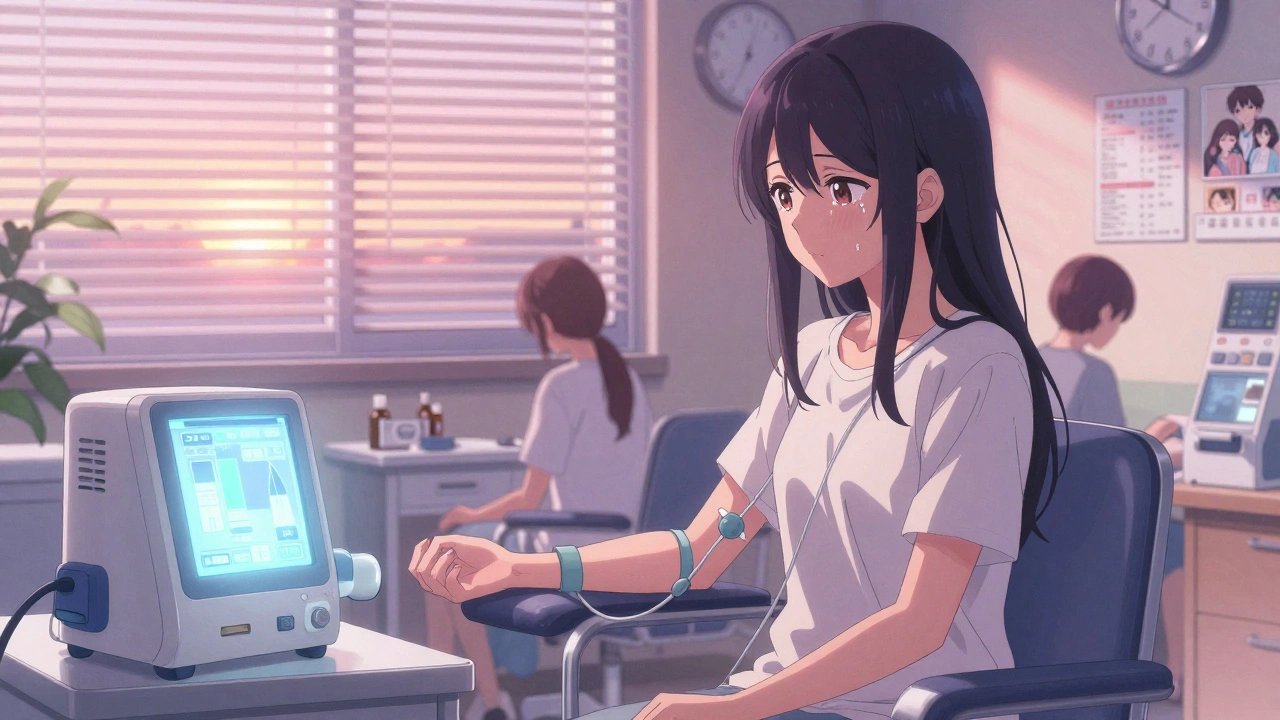
When your kidneys stop working, your body can’t clean your blood. Waste builds up. Fluid swells your legs. You get tired all the time. This isn’t just aging-it’s end-stage renal disease (ESRD), the point where kidneys have lost 90% of their function. Without treatment, you won’t survive. But what comes next? Dialysis? A transplant? And how does each choice change your life-not just medically, but every day?
What Happens When Kidneys Fail?
Your kidneys do more than make urine. They balance salt, remove toxins, control blood pressure, and make hormones that keep your bones and blood healthy. When they fail, it’s not a slow decline-it’s a system-wide collapse. Most people with ESRD have diabetes or high blood pressure. Together, these two conditions cause more than 70% of cases. Other causes include polycystic kidney disease, lupus, or long-term drug damage. Doctors measure kidney function with a number called GFR-glomerular filtration rate. If it drops below 15, you’re in ESRD. At this stage, your kidneys can’t keep up. You need help. There are only two options: dialysis or a transplant. Neither is perfect. But one gives you back your life. The other keeps you alive.Dialysis: Keeping You Alive, But at a Cost
Dialysis is a machine that does what your kidneys used to do. There are two types: hemodialysis and peritoneal dialysis. Hemodialysis means going to a clinic three times a week for 3 to 4 hours each visit. You’re hooked up to a machine that pulls blood out, cleans it, and puts it back. It’s exhausting. You’ll feel drained after each session. You can’t eat or drink freely-too much potassium or phosphorus can stop your heart. Your diet becomes a list of no’s: no bananas, no oranges, no potatoes, no processed foods. Even water is controlled. Peritoneal dialysis happens at home. You fill your belly with fluid through a tube, let it sit for hours, then drain it out. It’s done daily, often overnight with a machine. It gives more freedom, but it’s risky. Infections in the belly can land you in the hospital. You have to be meticulous-sterile gloves, clean surfaces, no shortcuts. Both types require strict lab checks. Your phosphate must stay between 3.5 and 5.5 mg/dL. Calcium must be under 9.5 mg/dL. Parathyroid hormone levels need constant monitoring. You’ll take vitamin D pills, phosphate binders, blood pressure meds, and sometimes iron infusions. It’s a full-time job just to stay stable. And the time? In-center hemodialysis takes 12 to 16 hours a week just for treatment-not counting travel, waiting, or recovery. Many patients quit jobs. Relationships strain. You can’t just hop in the car for a weekend trip. Your life shrinks to a schedule.Kidney Transplant: The Better Choice
If you’re healthy enough, a kidney transplant is the best option. Not just because it’s more effective-but because it lets you live again. Transplant recipients live longer. Five-year survival? 83% for transplant patients. For those on dialysis? Just 35%. That’s a 68% lower risk of death. You’re not just surviving-you’re living. You don’t need dialysis anymore. You eat normally. No more phosphate binders. No fluid limits. You can drink a glass of water without calculating. You can eat an apple. You can travel. You can sleep through the night. A 2021 study found transplant patients scored 82.4 out of 100 on quality-of-life surveys. Dialysis patients? 53.7. That’s a 28.7-point gap-bigger than the difference between being happy and being depressed. You’ll still need to take immunosuppressant drugs-tacrolimus, mycophenolate, steroids-to stop your body from rejecting the new kidney. These cost $1,500 to $2,500 a month. You’ll have more infections. You’ll need regular blood tests. But compared to dialysis? It’s a trade-off you can live with. Hospital visits drop by half. You’re not tied to a machine. You’re not waiting for a dialysis slot. You’re back in control.
Why Isn’t Everyone Getting a Transplant?
If it’s better, why do 71% of ESRD patients stay on dialysis? First, access. The transplant waiting list in the U.S. has over 90,000 people. Only 27,000 transplants happen each year. That’s a 3-year wait on average. Many die waiting. Second, eligibility. You can’t get a transplant if you have active cancer, severe heart disease, dementia, or uncontrolled addiction. Age isn’t a hard cutoff-but if you’re over 75 with other illnesses, you’re often ruled out. Third, referral delays. Doctors don’t always refer patients early. Guidelines say to refer when GFR drops below 30-years before dialysis is needed. But most patients aren’t referred until they’re already on dialysis. Only 5% of new dialysis patients are even on the transplant list before starting treatment. And then there’s race. African American patients are less likely to be referred for transplant, even when they’re just as sick. Studies show that after targeted education for doctors and patients, transplant referrals for Black patients jumped by 40%. The system wasn’t broken-it was ignored.Living Donors: The Hidden Advantage
The best transplants come from living donors. A kidney from a living person lasts longer. Survival rates? 95.5% at one year, 86% at five years. Deceased donor kidneys? 93.7% and 78.5% respectively. Living donors can be family, friends, or even strangers. You don’t need to be related. Blood type matters, but compatibility tests can sometimes make it work. The surgery for the donor is safe-most go home in 2 days. The recipient gets a kidney that starts working immediately. No waiting. No dialysis. Preemptive transplants-getting a kidney before ever needing dialysis-cut death risk even further. But they’re rare. Why? Because most people don’t know they’re candidates until it’s too late.
What’s Changing?
The system is slowly waking up. Medicare now covers ESRD care starting in the fourth month of dialysis. But the cost is huge-$35.4 billion a year, for just 1% of Medicare patients. That’s why new programs are pushing for earlier transplants. The Kidney Care Choices Model, launched in 2022, pays providers to refer patients early. The 21st Century Cures Act lets doctors use kidneys from older or sicker donors-expanding the pool by 15% since 2017. Living donor transplants are up 18% since 2018. More people are stepping forward. More hospitals are training staff to talk about transplants early. More patients are asking the right questions.What Should You Do?
If you have chronic kidney disease, don’t wait for dialysis. Talk to your doctor about transplant evaluation when your GFR hits 30. Get tested for compatibility. Ask if you have a living donor option. Even if you don’t know anyone, you can be listed on the waiting list while exploring donors. If you’re already on dialysis, ask: Can I be referred now? What’s my wait time? Am I eligible? Don’t assume you’re too old, too sick, or too far along. Many people are turned away without ever being properly evaluated. And if you’re healthy? Consider becoming a living donor. One kidney can give someone back their life. You’ll live normally. You won’t feel the difference. But they will.Final Reality
ESRD doesn’t have to mean giving up your life. Dialysis keeps you alive. A transplant lets you live. The difference isn’t just medical-it’s human. The system isn’t perfect. Wait times are long. Referrals are delayed. Disparities still exist. But progress is real. More people are getting transplants. More are living longer. More are living better. You don’t have to accept the status quo. Ask. Advocate. Act. Your kidneys may have failed. But your life doesn’t have to.Can you live a normal life after a kidney transplant?
Yes. Most transplant recipients return to work, travel, exercise, and enjoy meals without strict limits. They take daily immunosuppressants and attend regular checkups, but they’re no longer tied to dialysis machines. Studies show they report higher energy, better sleep, and improved mood compared to dialysis patients. Many say they feel like they got their life back.
How long does a transplanted kidney last?
A kidney from a living donor lasts about 15 to 20 years on average. A kidney from a deceased donor lasts 10 to 15 years. Some last longer-up to 30 years-with good care. If the transplant fails, you can go back on dialysis and re-list for another transplant. Many people have more than one transplant in their lifetime.
Is dialysis painful?
The dialysis process itself isn’t usually painful, but the side effects are tough. Low blood pressure during treatment causes nausea and cramps. The needle sticks for access can be uncomfortable. Many patients feel exhausted for hours after. Over time, the constant restrictions-diet, fluid, schedule-take a mental toll. It’s not the pain that wears people down-it’s the loss of freedom.
Can you drink alcohol after a kidney transplant?
Moderate alcohol is usually allowed after transplant-no more than one drink a day for women, two for men. But alcohol can interact with immunosuppressants and harm the liver, which already works harder after transplant. Always check with your doctor. Some patients are advised to avoid alcohol entirely, especially if they had alcohol-related kidney damage before.
Why do some people die waiting for a kidney?
There are far more people needing kidneys than available organs. About 3,000 new patients join the waiting list every month, but only 27,000 transplants happen each year. Many patients are too sick to wait. Others are older or have other health problems that make them higher risk. Some never get referred early enough. The gap between need and supply is growing.
Does Medicare cover kidney transplants?
Yes. Medicare covers 100% of the cost of the transplant surgery, hospital stay, and immunosuppressant drugs for 36 months after the transplant. After that, if you’re under 65 and disabled, you may still qualify for Medicare under your ESRD benefit. Private insurance or Medicaid may help cover costs beyond 3 years. The cost of anti-rejection drugs is the biggest ongoing expense-$1,500 to $2,500 a month.
Can you get a transplant without a living donor?
Yes. Most transplants come from deceased donors. You can be placed on the national waiting list and receive a kidney when one becomes available. But the wait is long-on average four years. Living donor transplants happen faster, have better outcomes, and don’t require dialysis first. If you don’t have a living donor, you can still be listed, but it’s important to start the process early.
What are the biggest risks after a transplant?
The biggest risks are infection and rejection. Immunosuppressant drugs weaken your immune system, so you’re more vulnerable to colds, flu, and even serious infections like pneumonia or COVID-19. Rejection can happen anytime, even years later. Signs include fever, swelling, pain near the transplant, and changes in urine output. Regular blood tests catch rejection early. Most cases can be reversed if caught in time.
James Kerr
December 3, 2025 AT 18:56Just wanted to say this post hit different. I’ve got a cousin who got a kidney from a stranger last year-she’s back hiking, cooking for her grandkids, even started a blog. No more dialysis schedule. Life didn’t just improve-it restarted.
Rashi Taliyan
December 3, 2025 AT 20:40My aunt was on dialysis for 4 years… she looked like a ghost. The day she got her transplant? She cried for an hour just holding a glass of water. No restrictions. No IVs. Just… freedom. 🥹💧
Kara Bysterbusch
December 5, 2025 AT 05:38While the medical facts presented here are both comprehensive and compelling, one cannot overlook the sociopolitical undercurrents that perpetuate disparities in transplant access. The systemic under-referral of marginalized populations-particularly African American and low-income patients-is not merely an oversight; it is a structural failure rooted in implicit bias and resource allocation inequities. Advocacy must be institutionalized, not incidental.
sagar bhute
December 7, 2025 AT 02:49Everyone talks about transplants like they’re magic, but most people don’t realize how many die waiting. And the drugs? You’re basically a lab rat for the rest of your life. This whole system is a scam designed to keep you dependent.
Cindy Lopez
December 7, 2025 AT 13:52There’s a comma missing after ‘sterile gloves’ in the peritoneal dialysis paragraph. Also, ‘no’s’ should be ‘no’s’ with an apostrophe. Small things, but they matter.
shalini vaishnav
December 8, 2025 AT 15:36Why do Western countries always act like they invented healthcare? In India, we’ve had community-based kidney care for decades. No waiting lists, no bureaucracy. People just help each other. This whole transplant obsession is just capitalism dressed up as compassion.
bobby chandra
December 9, 2025 AT 21:47Let’s be real-this isn’t just about kidneys. It’s about dignity. Dialysis steals your autonomy. Transplant gives it back. The numbers don’t lie: 82.4 vs 53.7 on quality of life? That’s not a statistic-that’s the difference between breathing and gasping. We need to stop treating this like a medical footnote and start treating it like a civil rights issue.
Ignacio Pacheco
December 9, 2025 AT 23:22So… we’re supposed to believe that a $2,500/month drug bill is a ‘trade-off you can live with’? Cool. So long as you’re not the one paying it. Meanwhile, the system keeps pretending it’s about choice when it’s really about who can afford to survive.
vinoth kumar
December 11, 2025 AT 12:59I work in a clinic in Bangalore. Last week, a 58-year-old man came in-he’d been on dialysis for 3 years. His daughter offered her kidney. We got her tested. Matched. Surgery next month. He cried. I cried. This isn’t just medicine. It’s love with a scalpel.
Gavin Boyne
December 12, 2025 AT 02:33It’s ironic, isn’t it? We spend billions keeping people alive with machines, but we’re terrified of the idea that one healthy person can give another person their life back. We treat organ donation like a miracle, when it’s really just… basic human decency. Why do we make it so hard to be good to each other?
Rashmin Patel
December 12, 2025 AT 09:16OMG I’m so glad someone finally said this! My uncle got a transplant from his neighbor in 2020-total stranger, same blood type, matched after 6 months of testing. Now he’s coaching soccer for his niece’s team. And guess what? He started a nonprofit to help others get tested! If you’re reading this and you’re healthy? Please, please, please consider becoming a donor. One kidney, infinite impact. 💪❤️🫀
Jim Schultz
December 13, 2025 AT 17:32…And yet, despite all this data, despite all the studies, despite the clear superiority of transplant outcomes… the system still waits for patients to beg. To plead. To scream. Why? Because power doesn’t move until it’s uncomfortable. And right now? It’s just… inconvenient.