
Most people assume a pharmaceutical patent lasts 20 years. That’s what the law says. But if you look at when a drug actually hits the market, the real clock starts ticking much later-and it runs out far sooner than you’d expect. The effective patent life for most new drugs is only 10 to 13 years, not 20. Why? Because the patent clock starts ticking the day the application is filed, not when the drug is approved. And that gap? It’s where most of the 20 years disappear.
The 20-Year Myth
The U.S. Patent and Trademark Office grants patents for 20 years from the filing date. That’s standard across nearly every country. But here’s the catch: by the time a drug makes it through preclinical testing, three phases of clinical trials, and FDA review, five to ten years have already passed. For many drugs, it’s closer to eight. That means when the drug finally reaches patients, it’s already halfway through its patent life. The remaining time on the clock? Often just 7 to 12 years. That’s not enough to recoup the average $2.6 billion spent to develop a single new medication.The Hatch-Waxman Act: A Fix That’s Been Exploited
In 1984, Congress passed the Hatch-Waxman Act to fix this exact problem. The idea was simple: if it takes years to get a drug approved, give the company back some of that lost time. The law allowed for Patent Term Extension (PTE)-up to five extra years-to make up for regulatory delays. But there’s a hard cap: no patent can extend beyond 14 years of market exclusivity after FDA approval. So even if a drug took nine years to get approved, the maximum total exclusivity you could get was 14 years, not 20. But here’s what happened next. Companies didn’t just rely on the original patent. They started filing secondary patents-on new formulations, new doses, new delivery systems, even new metabolites. These weren’t new drugs. They were tweaks. But they were enough to keep generics off the shelf. A 2023 R Street Institute study found that blockbuster drugs often have 20 to 30 patents attached to them. That’s not innovation. That’s a legal wall.Patent Thickets and the Evergreening Trap
When a drug becomes a blockbuster-earning over $1 billion a year-companies invest heavily in patent thickets. These are layers of overlapping patents designed to delay generic entry. One patent covers the active ingredient. Another covers the tablet coating. Another covers the extended-release version. Another covers the combo with a second drug. Each one gets its own 20-year term. Even if the original patent expires, the next one kicks in. And because generic manufacturers can’t challenge every patent at once, they’re forced into a game of legal whack-a-mole. The FDA’s Orange Book lists every patent tied to a brand drug. Generic companies have to check every single one before they can launch. And if the brand company sues within 45 days of a generic notice, the FDA must wait 30 months before approving the generic-even if the court later rules in the generic’s favor. That’s a huge delay. And it’s intentional.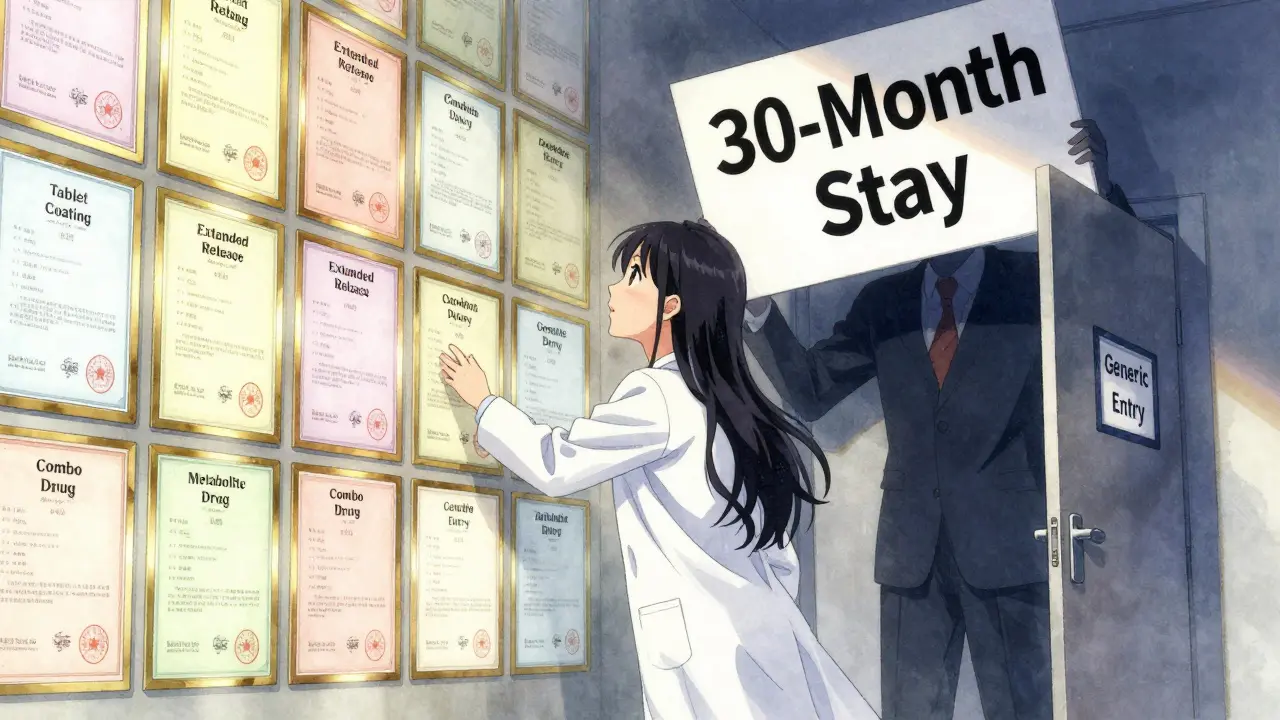
Regulatory Exclusivity: The Hidden Clock
Beyond patents, there’s another layer: regulatory exclusivity. These are separate protections granted by the FDA. They don’t rely on patents. They kick in automatically when a drug is approved.- New Chemical Entity (NCE) Exclusivity: 5 years of market protection, during which the FDA can’t even accept a generic application.
- New Clinical Investigation Exclusivity: 3 years for new uses or formulations of existing drugs.
- Orphan Drug Exclusivity: 7 years for drugs treating rare diseases (fewer than 200,000 patients in the U.S.).
- Pediatric Exclusivity: An extra 6 months added to any existing patent or exclusivity period.
International Differences: It’s Not Just the U.S.
The U.S. isn’t the only country wrestling with this issue. Canada offers a Certificate of Supplementary Protection (CSP), giving up to 2 years of extra protection after patent expiry. Japan allows up to 5 years of Patent Term Extension, similar to the U.S. But the EU has stricter rules. Their Supplementary Protection Certificate (SPC) system caps total market exclusivity at 15 years from initial approval, with no more than 5 years of extension. That’s tighter than the U.S. system, which, thanks to secondary patents, often lets drugs stay exclusive for 16 to 18 years.
The Real Cost: Billions at Stake
When a drug loses exclusivity, prices drop fast. Within a year, generic versions can cut the brand’s revenue by 80% to 90%. That’s why companies spend millions on lifecycle management-repackaging, reformulating, rebranding-to squeeze out every last month of exclusivity. EY estimates that by 2025, $250 billion in global drug sales will be at risk due to patent expirations. For companies, it’s not just about profit. It’s survival.Who Wins? Who Loses?
Patients and insurers lose when exclusivity lasts too long. Higher prices mean higher premiums, higher copays, and fewer people getting treatment. Generic manufacturers lose when patent thickets delay their entry. But innovators? They win-if they play the system right. Companies with strong R&D pipelines and legal teams that know how to navigate the Orange Book and the PTE process can extend exclusivity far beyond what Congress originally intended. The system was built to balance two goals: reward innovation and get affordable drugs to patients. But today, it leans heavily toward the first. The Hatch-Waxman Act didn’t anticipate patent thickets. It didn’t expect companies to file dozens of patents on the same molecule. It didn’t predict that 91% of drugs with patent extensions would keep their monopoly alive through secondary protections.What’s Next?
There’s growing pressure to reform this system. Courts are starting to strike down weak secondary patents. The FTC is investigating evergreening tactics. Some lawmakers are pushing to limit pediatric exclusivity extensions or cap the number of patents that can be listed in the Orange Book. But until there’s real change, the math stays the same: 20 years on paper. 10 to 13 years in reality. And for the biggest drugs? Maybe 16 to 18-with the help of a well-placed patent and a 30-month stay.Effective patent life isn’t about the law. It’s about strategy. And right now, the system favors those who know how to play it.
What is the difference between patent term and effective patent life?
The patent term is the legal length of protection-20 years from the filing date. Effective patent life is how long a drug actually has market exclusivity after accounting for the time spent in clinical trials and FDA review. That’s usually only 10 to 13 years, even though the patent says 20.
Can a drug’s patent be extended after it expires?
No, the original patent cannot be extended after it expires. But companies can file new patents on improvements-like new formulations or delivery methods-and those can block generics even after the original patent runs out. This is called ‘evergreening.’
How does the Hatch-Waxman Act affect generic drug entry?
Hatch-Waxman lets generic companies file applications before the brand patent expires. But if the brand company sues within 45 days of receiving the notice, the FDA must wait 30 months before approving the generic-unless the court rules faster. This delay gives brand companies time to negotiate or file more patents.
Do all drugs get patent term extensions?
No. Only drugs that underwent significant regulatory review can qualify. The extension is capped at 5 years, and the total market exclusivity can’t exceed 14 years from FDA approval. Also, the active ingredient must be new-no extensions for old drugs with minor changes.
Why do some drugs have 20+ patents?
High-revenue drugs attract aggressive patenting. Companies file patents on every possible variation: different doses, coatings, combinations, delivery methods, even manufacturing processes. These create a ‘patent thicket’ that makes it expensive and risky for generics to enter the market, even after the original patent expires.
Is the 14-year cap on market exclusivity still effective?
Not really. The 14-year cap applies only to patent term extensions. But companies use regulatory exclusivities-like orphan drug or pediatric exclusivity-to extend protection beyond that limit. A drug with NCE exclusivity (5 years) plus pediatric add-on (6 months) plus a patent extension (5 years) can easily hit 16 years of exclusivity without touching the 14-year cap.
Aadil Munshi
December 19, 2025 AT 04:26Let’s be real - this whole system is a rigged casino where the house always wins. Pharma companies don’t invent cures, they invent legal loopholes. That $2.6 billion R&D cost? Mostly just PR padding. The real profit comes from stacking patents like Jenga blocks until the whole damn tower collapses into generic hell. And we’re supposed to cheer?
Carolyn Benson
December 19, 2025 AT 20:02They call it innovation. I call it intellectual vandalism. You patent the color of the pill. The shape. The damn packaging. It’s not protecting innovation - it’s weaponizing bureaucracy. And the FDA? They’re just the bouncer letting the VIPs in while everyone else waits outside in the rain.
Frank Drewery
December 21, 2025 AT 17:51I get why companies do it - R&D is brutal and expensive. But the system’s broken. We need smarter rules, not more patents. Maybe cap the number of secondary patents per drug? Or require real clinical benefit for each one? There’s a middle ground here.
Danielle Stewart
December 21, 2025 AT 19:03As someone who’s watched a loved one struggle to afford insulin - this isn’t theoretical. It’s life or death. That 14-year cap sounds nice on paper, but with pediatric extensions and orphan drug loopholes? Real-world exclusivity is often 17+ years. That’s 17 years of people choosing between meds and rent.
mary lizardo
December 22, 2025 AT 23:59It is not merely a matter of patent law-it is a systemic failure of moral imagination. The pharmaceutical industry has transmuted the sacred covenant of public health into a proprietary commodity, and the regulatory apparatus has become its complicit enabler. The term 'evergreening' is a euphemism for predatory rent-seeking. One must ask: who benefits, and at whose expense?
Adrienne Dagg
December 23, 2025 AT 02:23💀 Big Pharma: ‘We need to recoup costs!’
Me: ‘But your CEO made $80M last year.’
Patients: ‘I can’t afford my pill.’
Also Big Pharma: ‘We’re saving lives!’
Also me: ‘No, you’re just milking the system.’
Glen Arreglo
December 23, 2025 AT 22:00Look, I get it. Innovation needs protection. But when you file 27 patents on the same molecule just to delay a $0.10 generic pill? That’s not capitalism. That’s feudalism with a FDA stamp. We need to treat drug pricing like a public utility - not a stock ticker.
shivam seo
December 25, 2025 AT 16:13U.S. is the worst. In Australia, we’ve got PBS - if your drug’s too expensive, we just don’t pay for it. No 30-month stays, no patent thickets. Generics hit the market fast. You guys are just addicted to corporate welfare. Fix your own mess.
benchidelle rivera
December 27, 2025 AT 04:53Every time I see a patient skip doses because they can’t afford their medication, I think about this. The patent system was never meant to be a profit-maximization engine. It was meant to incentivize discovery - not legal gymnastics. We need structural reform, not band-aids. And we need it now.
Andrew Kelly
December 28, 2025 AT 06:50Who really owns the patent? The company? Or the taxpayers who funded 70% of the basic research through NIH grants? We paid for the science. Then they privatized the profits. That’s not capitalism - that’s theft with a law degree. And the FDA? Just a puppet with a rubber stamp.
Isabel Rábago
December 30, 2025 AT 06:29It’s not about the 20 years. It’s about the 10 years of silence while the drug sits in a lab. The real crime isn’t the extension - it’s the lack of transparency. Why can’t we see how much each trial actually cost? Why is R&D a black box? If we knew the truth, we’d know this whole system is a lie.
bhushan telavane
January 1, 2026 AT 06:24Bro, in India we make generics for pennies. You guys spend millions fighting them in court. Meanwhile, people in Africa die because they can’t get the meds you’re hoarding. This isn’t innovation - it’s greed with a PhD.
Mahammad Muradov
January 2, 2026 AT 07:35Let me explain this to you like you’re five: patent = 20 years. Time to get FDA approval = 8 years. So 12 left. But then they file 30 more patents on the same pill. So now it’s 18 years. Then they get pediatric extension. Then orphan status. Then they sue the generic company. So now it’s 22 years. You’re not getting it because you’re not paying attention.
Connie Zehner
January 3, 2026 AT 22:12OMG I just realized - the reason my antidepressant costs $500 is because they patented the color of the capsule?! I’m crying. 😭 I literally can’t afford to live. This is why I hate America. 💔
Kelly Mulder
January 4, 2026 AT 12:54It is a profound indictment of modern governance that the United States, the self-proclaimed beacon of innovation, has allowed its regulatory framework to be subverted by corporate interests to such an egregious degree. The Hatch-Waxman Act, once a noble compromise, has been perverted into a weapon of monopolistic entrenchment. The data are irrefutable. The moral failure is undeniable.