

Every year, thousands of people end up in the hospital not because they took too much medicine, but because they took the right medicine with the wrong thing. A glass of grapefruit juice. A daily turmeric capsule. A handful of spinach salad. These aren’t dangerous on their own-but when mixed with certain drugs, they can turn harmless habits into life-threatening mistakes.
Why Your Morning Smoothie Could Be Dangerous
You’re healthy. You eat well. You take your blood pressure pill and your statin. You add a scoop of protein powder, a handful of kale, and a spoonful of flaxseed. Sounds smart, right? Not if you’re on simvastatin. Grapefruit juice-yes, even one glass-can make your statin levels spike by up to 15 times. That’s not a typo. That kind of spike can cause rhabdomyolysis, a condition where muscle tissue breaks down and floods your kidneys with toxic proteins. One study found that people who drank grapefruit juice while on simvastatin were over 10 times more likely to suffer muscle damage than those who didn’t. It’s not just grapefruit. Pomegranate juice, Seville oranges, and even some types of pomelo do the same thing. They block an enzyme in your gut called CYP3A4, which normally helps break down drugs before they enter your bloodstream. When that enzyme is shut down, your body absorbs way more of the drug than it should. The result? Toxic levels. And you won’t feel it coming until it’s too late.Supplements Aren’t Always Safe
If you think supplements are harmless because they’re “natural,” you’re in for a surprise. The FDA doesn’t test supplements for safety or interactions before they hit the shelf. That means a bottle labeled “St. John’s wort for mood support” could be quietly sabotaging your birth control, your antidepressant, or your heart transplant medication. St. John’s wort is one of the worst offenders. It turns on a liver enzyme called CYP3A4-so hard and fast that it can flush out half your prescription drugs before they even start working. In just two weeks, it can drop cyclosporine levels by 70%. That’s enough to make a transplant patient reject their new organ. It can also cut the effectiveness of SSRIs like sertraline by so much that depression returns-or worse, triggers serotonin syndrome: a dangerous spike in body temperature, confusion, rapid heartbeat, and muscle rigidity. Emergency rooms see this every month. Ginkgo biloba? It thins your blood. So does garlic. So does fish oil. If you’re on warfarin, aspirin, or clopidogrel, adding any of these can turn a small cut into a bleeding emergency. There are over 30 documented cases of brain bleeds linked to ginkgo and blood thinners. One woman in her 70s took ginkgo for memory and warfarin for atrial fibrillation. She didn’t bleed out-but her INR shot to 8.5. Normal range? 2.0 to 3.0. She spent a week in the ICU.Vitamin K: The Quiet Saboteur
Warfarin works by blocking vitamin K, which your body needs to clot blood. So if you suddenly eat a big bowl of spinach, kale, or broccoli, you’re flooding your system with vitamin K-and undoing your medication. A 2018 study showed that 150 grams of cooked spinach (about a cup) could slash warfarin’s effect by 30-40% in under 24 hours. That’s not a small change. That’s a jump from safe to stroke-risk territory. The key isn’t to stop eating greens. It’s to keep your intake steady. Eat the same amount every day. If you normally have a small salad, don’t suddenly switch to a giant one on Monday. If you take warfarin, your doctor will check your INR weekly at first-not because you’re doing something wrong, but because your diet can shift without you even noticing. Cranberry juice? It’s not just a myth. There are 28 documented cases of people on warfarin who started drinking cranberry juice and ended up with dangerously high INR levels. Some hit over 8.0. That’s not a warning sign. That’s a red flag for internal bleeding.
What You’re Probably Missing
Most people don’t realize how many things can interfere with their meds. Coffee? It can slow down how fast your body clears certain antidepressants. Alcohol? It can make your painkillers or sedatives hit harder-sometimes fatally. Dairy? It can block absorption of antibiotics like tetracycline and fluoroquinolones. You can’t take them with milk, yogurt, or cheese. Wait at least two hours. Even over-the-counter stuff matters. Cold medicines with pseudoephedrine can raise your blood pressure if you’re on beta-blockers. Antacids with aluminum or magnesium can make your thyroid meds useless. And don’t forget about herbal teas. Chamomile? It can boost the effect of blood thinners. Licorice root? It can mess with your potassium levels and make diuretics dangerous.Who’s Responsible for Keeping You Safe?
You are. But you’re not alone. Doctors don’t always ask about supplements. A 2022 study found that 70% of patients don’t tell their doctor they’re taking anything beyond prescriptions. Why? Because they think it’s not important. Because they don’t know it could hurt. Because they’re embarrassed. Pharmacists are your best hidden ally. They see every prescription you fill. They know what you’re taking. And they’re trained to catch interactions. If you walk into a pharmacy with a list of everything you take-prescriptions, OTC meds, vitamins, herbs, teas, energy drinks-they can spot the red flags before you even leave the counter. The American Pharmacists Association says pharmacist-led reviews reduce bad reactions by 22%. That’s not a small number. That’s life-saving.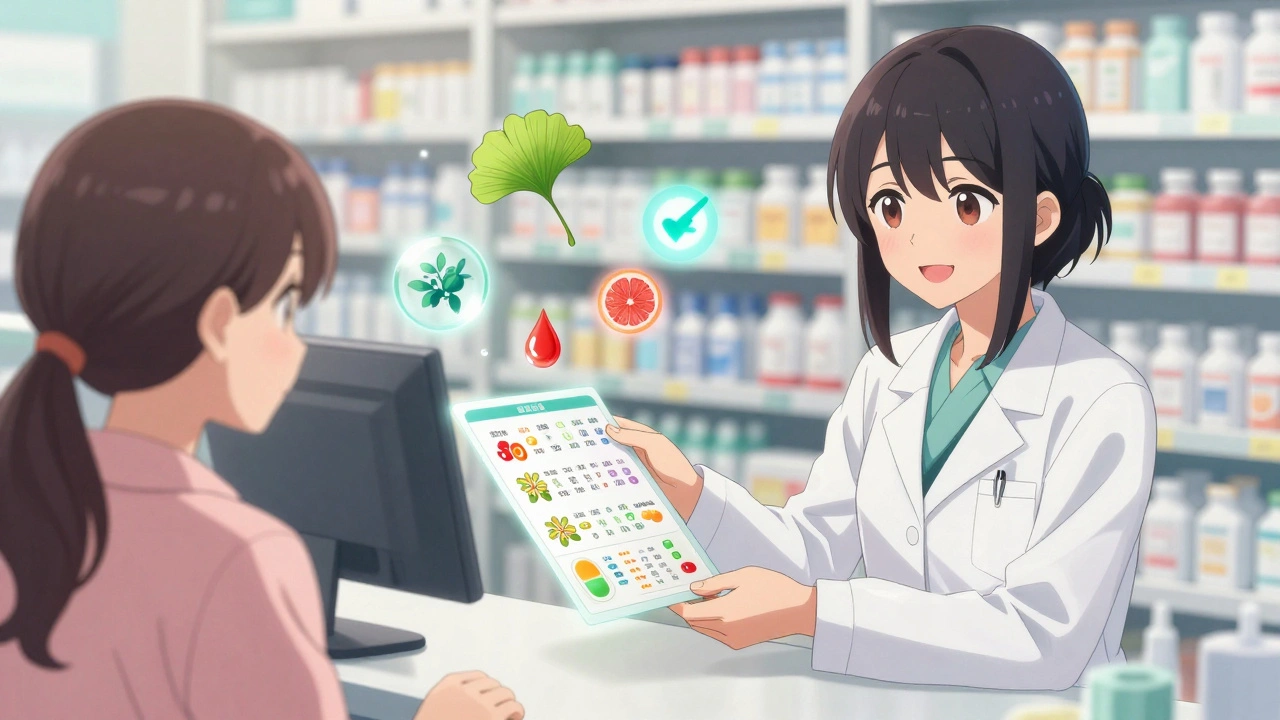
What You Should Do Today
1. Write down everything you take. Not just pills. Include: all supplements, herbal teas, vitamins, minerals, protein powders, and even over-the-counter pain relievers. Don’t forget the ginseng tea you drink every morning or the melatonin you take before bed. 2. Bring it to every appointment. Every time you see a doctor, nurse, or pharmacist-hand them the list. Don’t assume they remember. Don’t assume they’ll ask. 3. Use free tools. MedlinePlus has a free drug interaction checker. Just type in your meds and supplements. It won’t catch everything, but it’ll flag the big ones. 4. Don’t start anything new without asking. Before you buy that new “immune booster” or “joint support” supplement, ask your pharmacist: “Could this interfere with anything I’m already taking?” 5. Be consistent with food. If you’re on warfarin, eat the same amount of vitamin K every day. If you’re on statins, avoid grapefruit. If you’re on antibiotics, don’t take them with dairy. Small habits matter more than you think.It’s Not About Fear-It’s About Awareness
This isn’t about scaring you off supplements or healthy foods. It’s about making sure you get the full benefit of your meds without accidentally poisoning yourself. You’re not being paranoid. You’re being smart. The numbers don’t lie: drug interactions cause 3-5% of all hospital admissions. That’s tens of thousands of people every year in the U.S. alone. And most of those cases are preventable. The next time you reach for a pill, pause. Ask yourself: What else am I taking? What did I eat today? What did I drink? And if you’re not sure? Ask someone who knows. Your body doesn’t know the difference between a pill and a berry. It just reacts. And sometimes, that reaction can kill you.Can I still eat spinach if I’m on warfarin?
Yes-but keep your intake consistent. Don’t suddenly eat a big salad one day and none the next. The goal is to keep your vitamin K levels steady. The National Academy of Medicine recommends 90mcg daily for women and 120mcg for men. A cup of cooked spinach has about 830mcg, so you don’t need to avoid it-just avoid big swings.
Is St. John’s wort safe if I’m not on any medication?
It’s not recommended even then. St. John’s wort can cause side effects like anxiety, dizziness, and increased sun sensitivity. It also interacts with many common drugs you might start taking later-like birth control, asthma inhalers, or even certain heart medications. There’s no reason to take it unless you’re under medical supervision.
Do all supplements have interaction warnings?
No. Only about 29% of supplement labels in the U.S. include any interaction warning. That’s because supplements aren’t regulated like prescription drugs. You can’t assume safety just because something is labeled “natural” or “herbal.” Always check with a pharmacist before taking anything new.
Can grapefruit affect my blood pressure medicine?
Yes. Grapefruit can increase levels of certain calcium channel blockers like amlodipine, diltiazem, and felodipine. This can cause your blood pressure to drop too low, leading to dizziness, fainting, or even heart problems. It can also interfere with some statins and anti-anxiety meds. If you’re on any prescription, assume grapefruit is off-limits unless your doctor says otherwise.
What should I do if I think I’ve had a drug interaction?
Stop taking the supplement or food that might be causing the issue, and call your doctor or pharmacist immediately. If you have symptoms like unusual bruising, confusion, rapid heartbeat, muscle pain, or dark urine, go to the ER. Don’t wait. Many interactions build up slowly-but when they hit, they hit hard.
Can my pharmacist check my supplements for interactions?
Absolutely. Pharmacists are trained to review all medications-including vitamins and herbs. Bring your full list to your pharmacy every time you pick up a new prescription. Many pharmacies offer free medication reviews. It takes 15 minutes. It could save your life.
Are there any supplements that are generally safe with most medications?
Some are lower risk, like basic multivitamins without herbs, or calcium and vitamin D in standard doses. But even these can interfere with thyroid meds or antibiotics if taken at the same time. The safest rule? Don’t take anything new without checking. No supplement is truly “safe” until you know how it reacts with your specific meds.
Kumar Shubhranshu
December 6, 2025 AT 10:46St. John’s wort and warfarin combo is a death sentence waiting to happen. People don’t realize supplements aren’t regulated. Just because it’s herbal doesn’t mean it’s safe. Stop being naive.
Andrew Frazier
December 7, 2025 AT 15:30Wow. So now I can’t even drink grapefruit juice without a PhD in pharmacology? 😂 I take simvastatin and I’ve been chugging grapefruit smoothies for 5 years. Still alive. Probably just lucky. Or maybe your stats are fake.
Mayur Panchamia
December 9, 2025 AT 11:19YOU’RE ALL IGNORANT!!! This isn’t just ‘food and meds’-this is CORPORATE PHARMA’S SECRET WAR AGAINST NATURAL HEALTH! They don’t want you to know that grapefruit, turmeric, and garlic are cheaper than their overpriced pills! They silence studies! They bury data! The FDA is a puppet! Your ‘doctor’ is paid by Big Pharma to keep you hooked on poison!!!
Nava Jothy
December 10, 2025 AT 13:57I just cried reading this 😭 I’ve been taking St. John’s wort for 3 years and my antidepressant feels like it’s on mute… I thought I was just ‘getting used to it’… I’m so stupid… I’m deleting everything now. Thank you for this. 🙏
Ibrahim Yakubu
December 11, 2025 AT 03:21Actually, the real issue is that Western medicine ignores traditional healing systems. In Ayurveda, we’ve known about these interactions for 5,000 years. But you guys need a 10-page article to figure out that turmeric + blood thinners = bad. Sad.
Saketh Sai Rachapudi
December 12, 2025 AT 08:36grapefruit juice is fine if u just dont drink it at the same time as ur meds… i mean come on people its not rocket science… i take my statin at night and drink grapefruit in the morning… problem solved… u just need to be smart not paranoid
joanne humphreys
December 12, 2025 AT 18:38I appreciate how thorough this is. I’ve had my INR fluctuate before and didn’t know why. Now I know it’s because I went from one spinach salad a week to three. Small changes matter. Thanks for the clarity.
pallavi khushwani
December 14, 2025 AT 17:29It’s wild how we treat food like it’s separate from medicine. Your body doesn’t care if something is ‘natural’ or ‘prescribed’-it just reacts. Maybe we need to stop seeing pills and kale as opposites and start seeing them as part of the same system. We’re not machines. We’re messy, biological beings.
Billy Schimmel
December 15, 2025 AT 07:58So… if I take my blood pressure med with milk, I’m basically just giving my doctor a free vacation? 😅
Shayne Smith
December 16, 2025 AT 10:37My grandma took ginkgo for ‘memory’ and ended up in the ER. She didn’t even know it was a supplement. She thought it was just ‘vitamin B.’ This needs to be on every pharmacy shelf. Like, a big poster. ‘Your turmeric could kill you.’
Akash Takyar
December 17, 2025 AT 22:01As a pharmacist, I can confirm: 90% of patients never mention their supplements. I’ve seen patients on warfarin take fish oil, turmeric, and green tea daily-and then panic when they bruise easily. We’re not here to judge. We’re here to help. Please, just bring your list.
Arjun Deva
December 19, 2025 AT 17:43THIS IS ALL A LIE. The FDA, WHO, and Big Pharma are pushing this fear to make you buy more pills. Grapefruit juice is a miracle cure. They banned it in 1998 because it made statins too cheap. The ‘rhabdomyolysis’ cases? Fabricated. The ‘INR spikes’? Lab errors. Wake up. You’re being manipulated.