

When you have diabetes, exercise shouldn’t feel like a gamble. Yet for many, the fear of a sudden blood sugar drop keeps them from moving - even when they know it’s good for them. The truth? You can work out safely. It just takes a little planning. Preventing lows during workouts isn’t about avoiding activity - it’s about understanding how your body responds and adjusting before you start.
Why Exercise Drops Your Blood Sugar
When you move, your muscles need fuel. They pull glucose from your bloodstream - even without insulin. That’s great for lowering high blood sugar, but if you’re on insulin or certain medications, it can push your levels too low. This isn’t just during the workout. It can keep happening for up to three days after. That’s why people with type 1 diabetes often crash hours later, even after a perfectly fine session. The American Diabetes Association says about half of adults with type 1 diabetes avoid exercise because they’re scared of lows. But you don’t have to be one of them. The key is knowing your numbers and timing.What Your Blood Sugar Should Be Before You Start
Don’t just guess. Check your glucose 15 to 30 minutes before you begin. Here’s what to do based on your reading:- Below 90 mg/dL: Eat 0.5 to 1.0 gram of carbs per kilogram of body weight. For a 70 kg person, that’s 35 to 70 grams - think a banana and a handful of crackers.
- 90-150 mg/dL: Still eat carbs. Aim for the same amount. This isn’t optional. Even if you feel fine, your body doesn’t know that.
- Below 100 mg/dL: The ADA recommends 15-20 grams of fast-acting carbs. A juice box, 4 glucose tablets, or 6 hard candies will do. Wait 15 minutes, check again. If it’s still low, repeat.
- Over 150 mg/dL: You’re probably safe, but monitor closely. Some experts, like Dr. Anne Peters, suggest pushing to 150-180 mg/dL before intense workouts to give yourself a buffer.
Insulin on Board: The Hidden Risk
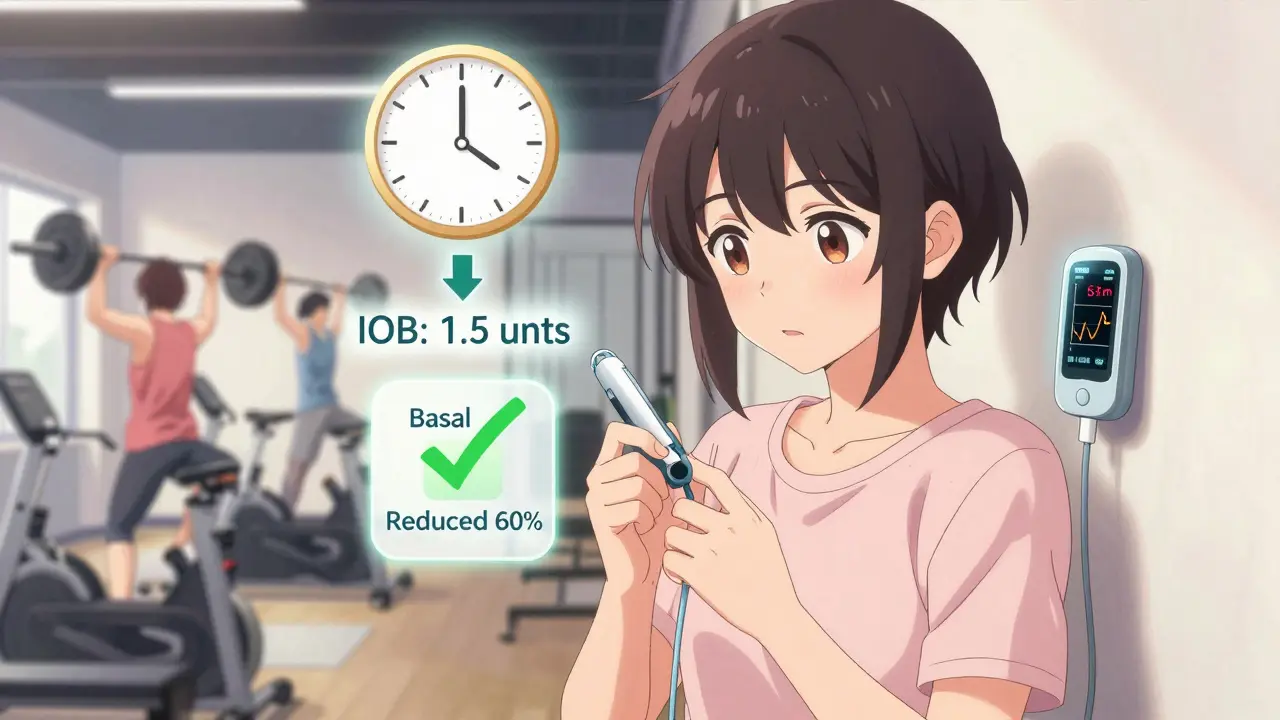
This is where most people get caught off guard. If you’ve taken insulin in the last few hours, some of it is still working - that’s called insulin on board (IOB). During exercise, that active insulin doesn’t just sit there. It can act like 2-3 times more insulin than normal. That’s why two identical workouts can lead to wildly different results. UCLA Health says: “The more insulin you have on board, the higher the likelihood of a low glucose.” So before you head out, check your pump or insulin pen log. If your IOB is over 1.2 units, you’re at risk. Here’s how to adjust:- Insulin pump users: Reduce your basal rate by 50-75% starting 60-90 minutes before exercise. Some systems, like the Tandem t:slim X2 pump (approved in March 2023), now do this automatically with their Exercise Impact feature.
- Multiple daily injection users: Cut your pre-workout bolus by 25-50%. If you’re doing a long session, consider reducing your long-acting dose the night before - especially if you exercise in the afternoon.
What Kind of Exercise Is Safest?
Not all movement is equal when it comes to blood sugar. Aerobic workouts - like running, cycling, or swimming - tend to drop glucose steadily. But resistance and high-intensity training? They can protect you. Research shows:- A 10-second all-out sprint before or after your main workout can blunt the drop. One user on Diabetes Daily said adding this cut their lows from four times a week to one every two weeks.
- Resistance training (weight lifting, bands, bodyweight) raises glucose during the session. Doing 45 minutes of strength work before 45 minutes of cardio cut glucose drops from 166 to 124 mg/dL in one study.
- HIIT (High-Intensity Interval Training) with short bursts (5-15 seconds) reduces lows both during and after. It’s not just about intensity - it’s about the pattern.
- Circuit training (minimal rest, high reps) can be risky. It mimics long aerobic sessions and often causes delayed lows.
What to Do During Your Workout
You checked your numbers. You adjusted your insulin. But things change. That’s why you need to check again every 30-60 minutes during longer sessions. If you’re using a CGM, great - but don’t rely on alerts alone. They can lag. Carry fast-acting carbs with you. Always. Not just in your pocket - in your hand, on your wrist, in your sports bra. You won’t remember if you have to stop and dig through your bag. Glucose gels, juice boxes, or even candy work. Don’t wait for symptoms like shakiness or dizziness. By then, it’s too late.Post-Workout: The Silent Danger
The biggest risk isn’t during the workout - it’s hours later. About 70% of people with type 1 diabetes get a low 6-12 hours after exercise. That’s why you can’t just go to bed after a run and assume you’re fine. Here’s what works:- Check your glucose before bed. If it’s below 120 mg/dL, eat a snack with 15 grams of carbs and some protein - like peanut butter on toast or a small cheese stick with an apple.
- Set an alarm to check again in 2-3 hours if you exercised hard or late in the day.
- Use your CGM’s overnight alerts. Most modern devices let you adjust low alerts for nighttime.
Technology Is Your Ally
CGMs have changed everything. In 2022, 68% of type 1 diabetes users with CGMs checked their glucose before exercise - compared to just 42% without. Dexcom’s G7, released in October 2022, even has an “exercise mode” that lowers alert thresholds by 20 mg/dL during activity so you’re warned earlier. And it’s getting smarter. The Tandem t:slim X2 pump now predicts glucose drops based on your past workouts and adjusts insulin automatically. Clinical trials show this cuts lows by over 30%. The next step? Artificial pancreas systems that deliver glucagon during exercise. Early results from the NIH’s Exercise-AP trial show 52% fewer lows. These aren’t future tech - they’re here now.
Real-Life Strategies That Work
People with diabetes have figured this out. Here’s what’s working:- “I do a 10-second bike sprint before my 30-minute walk. No more crashes.” - u/DiabeticAthlete, Diabetes Daily
- “I reduce my basal by 60% 90 minutes before gym day. I’ve gone from 3 lows a week to none.” - T1D Exchange member
- “I eat 20g of carbs 20 minutes before I run. I also drink a protein shake after. No overnight lows.” - Reddit user, r/Type1Diabetes
What Not to Do
Avoid these common mistakes:- Skipping pre-workout carbs because you “feel fine.”
- Exercising during peak insulin action (usually 1-3 hours after a bolus).
- Not checking glucose after exercise because “it’s over.”
- Using alcohol before or after - it blocks your liver from releasing glucose.
- Assuming your response will be the same every time. Stress, sleep, weather, and hormones all change things.
Final Thoughts
Exercise isn’t a threat to your diabetes - it’s one of the best tools you have. But you need to treat it like a variable, not a constant. The same workout on Monday and Friday can give you two different results. That’s normal. Start small. Pick one thing: check your glucose before your next workout. Then add a pre-workout snack. Then try a short sprint. Slowly, you’ll build confidence - and your body will learn. You don’t have to be perfect. You just have to be consistent. And you’re not alone. Millions are doing this every day - and so can you.Can I exercise if my blood sugar is below 90 mg/dL?
No - not without first raising it. Eat 0.5 to 1.0 gram of carbs per kilogram of body weight, wait 15 minutes, and recheck. Only start exercising if your glucose is above 90 mg/dL. Pushing through a low can lead to a dangerous drop.
Do I need to eat carbs during short workouts?
For workouts under 30 minutes, you usually don’t need to eat during - if you’ve eaten enough beforehand. But if your pre-workout glucose is between 90-120 mg/dL, have a small snack (15g carbs) ready just in case. Your body can still drop unexpectedly.
Why do I get lows hours after exercise?
After exercise, your muscles keep pulling glucose from your blood to refill their stores. Your body also becomes more sensitive to insulin for up to 72 hours. This is normal - but it means you need to monitor and eat a bedtime snack if your glucose is below 120 mg/dL.
Should I reduce my insulin before exercise?
Yes - especially if you’re on insulin. Pump users should reduce basal rates by 50-75% for 60-90 minutes before exercise. Injection users should reduce pre-meal boluses by 25-50%. The more insulin you have on board, the higher your risk of a low.
Is it safer to lift weights than run?
Generally, yes. Resistance training raises blood sugar during the session, while aerobic exercise tends to lower it. Combining strength training before cardio can cut glucose drops by over 30%. A 45-minute weight session before a 45-minute bike ride is one of the most effective strategies.
Scott Conner
February 7, 2026 AT 21:08Been doing this for 5 years now. Check my CGM before every workout. If it's under 100, I eat a banana and a spoon of peanut butter. No more crashes. Simple as that.
Tatiana Barbosa
February 9, 2026 AT 05:21YESSSS this is life-changing info!! 💪 I used to skip workouts because I was terrified of lows. Now I do 10-second sprints before my walk and I’m actually excited to move again. My A1c dropped 1.2 points in 3 months. You got this!!
MANI V
February 11, 2026 AT 01:38People these days treat diabetes like it’s a video game. You don’t just ‘eat a banana’ and call it a day. This is serious. You’re playing with your pancreas. If you don’t track IOB to the decimal, you’re asking for a coma.
Susan Kwan
February 12, 2026 AT 21:27So let me get this straight - you’re telling me I have to eat carbs before I work out… even if I feel fine? Wow. I never thought my body needed a permission slip to burn calories.
Ryan Vargas
February 14, 2026 AT 17:20The entire premise of this article assumes that the human body is a predictable machine. But biology is not a spreadsheet. Insulin kinetics are chaotic. Glucose flux is non-linear. The notion that you can ‘adjust’ your basal rate by 50-75% and expect consistency ignores the entropic nature of metabolic feedback loops. We’re not coding a PID controller - we’re managing a living, breathing, hormone-drenched organism. And yet, the industry sells this like it’s a firmware update.
Meanwhile, the real issue is systemic: pharmaceutical companies profit from insulin dependence. The fact that we’re being told to ‘reduce bolus’ instead of ‘rethink the entire insulin paradigm’ is the real epidemic. The pump doesn’t cure diabetes. It monetizes it.
Tasha Lake
February 16, 2026 AT 02:45IOB is such a game-changer. I didn’t even know what it meant until last year. Now I check it like a stock ticker. If it’s over 1.2, I delay my run. Game. Changed.
Simon Critchley
February 16, 2026 AT 03:12LOL I tried the HIIT thing and ended up in the ER. My CGM went from 140 to 48 in 12 mins. Now I just do yoga and call it ‘movement’. The pump can’t fix stupid. Or my laziness.
Also, anyone else notice how every ‘expert’ says ‘check your glucose’ but no one says ‘check your mental health’? Like, I’m tired of being a diabetic robot.
Ritteka Goyal
February 17, 2026 AT 11:48India me bhi yeh sab hota hai! Mere dost ka 10 second sprint ka idea kaam karta hai. Bas thoda sa carb lena padta hai. CGM kaafi helpful hai, lekin humare yahan 2000 rupees ka device nahi milta. 😅
Tricia O'Sullivan
February 19, 2026 AT 01:48Thank you for this comprehensive and thoughtful overview. The clinical precision of the recommendations is both reassuring and practical. I appreciate the inclusion of real-world data points alongside established guidelines.
Brandon Osborne
February 19, 2026 AT 14:05YOU’RE ALL JUST LIVING IN DENIAL. YOU THINK YOU’RE ‘MANAGING’ DIABETES? YOU’RE JUST SURVIVING BECAUSE TECHNOLOGY IS HOLDING YOU UP. YOUR PUMP ISN’T A TOOL - IT’S A CRUTCH. YOUR CGM ISN’T A SAFETY NET - IT’S A LIE TOLD TO KEEP YOU FROM QUITTING. YOU’RE NOT ‘FIGHTING’ - YOU’RE JUST BEING MANIPULATED BY BIG PHARMA. I DIDN’T NEED A PUMP. I DIDN’T NEED A CGM. I JUST STOPPED EATING CARBS. AND I’M STILL ALIVE.
Marie Fontaine
February 20, 2026 AT 03:27I do the 10-second sprint too!! 🎉 And I put glucose gels on my wrist so I don’t forget. It’s wild how much it helps. My husband says I’m obsessed but I say - I’m alive 😘
Elan Ricarte
February 22, 2026 AT 03:13Let’s be real - this whole ‘pre-workout carb’ thing is just a Band-Aid on a hemorrhage. The real problem? Insulin’s half-life doesn’t care about your cardio schedule. You’re treating symptoms, not root causes. And don’t get me started on ‘basal reductions’ - that’s just sugar-coated insulin starvation. The system is rigged. They want you dependent. They want you checking. They want you afraid. You’re not managing diabetes. You’re managing fear.
But hey, at least your CGM blinks pretty colors while you’re dying inside.
Angie Datuin
February 23, 2026 AT 03:55I’ve been doing this for 12 years. The hardest part isn’t the numbers. It’s the guilt. I feel like I’m failing if I have a low. But this post reminded me - it’s not failure. It’s data. And data can be fixed.
Camille Hall
February 24, 2026 AT 15:00This is so helpful. I’ve been avoiding running because I didn’t know how to adjust. Now I’m trying the strength-before-cardio combo next week. Thank you for breaking it down so clearly.
THANGAVEL PARASAKTHI
February 24, 2026 AT 16:16Bro, I reduce basal 60% before gym. And I eat 20g carb 20 min before. No lows since 3 months. Try it. Life changed. 💪