
Biosimilar Savings Calculator
Cost Calculator
See how much you could save with biosimilars. Biosimilars typically cost 15-30% less than original biologic drugs.
Your Savings
Annual Savings:
$0
3-Year Savings:
$0
5-Year Savings:
$0
When you hear the word biosimilar, you might think: Is this just a cheaper copy? Can I really trust it? It’s a fair question. After all, biologic drugs - the ones made from living cells, not chemicals - are some of the most powerful and expensive treatments we have. They treat rheumatoid arthritis, Crohn’s disease, cancer, and even severe psoriasis. But they often cost over $20,000 a year. That’s why biosimilars exist: to bring the same results at a lower price. And the data? It’s clear. Biosimilars are not just similar. They’re safe. They’re effective. And millions of patients are already using them without issue.
What Exactly Is a Biosimilar?
A biosimilar isn’t a generic drug. Generics are exact copies of chemical pills. Biosimilars are copies of complex biological medicines. Think of it like this: a generic aspirin is made from the same molecule every time. A biosimilar is like making a new loaf of bread using the same recipe, yeast, and flour as the original - but baked in a different oven. The result? Nearly identical. The European Medicines Agency (EMA) approved the first biosimilar in 2006. The U.S. followed in 2015 with Zarxio, a copy of filgrastim used to boost white blood cells after chemotherapy.
Regulators don’t just take a manufacturer’s word for it. To get approved, a biosimilar must go through years of testing. Analytical studies check its molecular structure. Nonclinical tests look at how it behaves in cells and animals. Clinical trials compare it head-to-head with the original drug. The FDA requires proof that there are no clinically meaningful differences in safety, purity, or potency. That’s not a marketing phrase. It’s a legal standard.
The Evidence: Safety and Effectiveness Are Proven
Let’s cut through the noise. The biggest concern people have is: What if it doesn’t work as well? Or worse - What if it causes new side effects? The data says otherwise.
Sandoz, one of the largest biosimilar manufacturers, tracked over 1.3 billion patient treatment days across eight different biosimilars. That’s more than 3.5 million years of combined patient exposure. Their 2023 review, published in PMC10684613, found no increase in adverse events compared to the original biologics. In fact, the benefit-risk profile was identical.
One study, ClinicalTrials.gov NCT03729674, followed over 1,200 patients with autoimmune diseases. They switched from the original drug to a biosimilar - and then back again. Researchers measured disease activity, flare-ups, hospital visits, and lab results. No meaningful difference. Not even a slight dip in effectiveness. Another study looked at patients who switched multiple times - from reference to biosimilar, then to another biosimilar, then back. Still no safety signals.
Immunogenicity - the risk of your body developing antibodies against the drug - is a real concern with biologics. But studies show biosimilars trigger the same low rate of anti-drug antibodies as the originals. New testing tools today can detect even tiny immune responses, and they still show no difference.
Cost Savings Aren’t Just a Marketing Pitch
Biosimilars cost 15% to 30% less than the original biologic. In some markets, like Europe, savings are even higher. In the U.S., from 2015 to 2022, biosimilars saved the healthcare system $31 billion. Projected savings through 2030? Over $300 billion. That’s not a guess. It’s from the Association for Accessible Medicines, using real claims data.
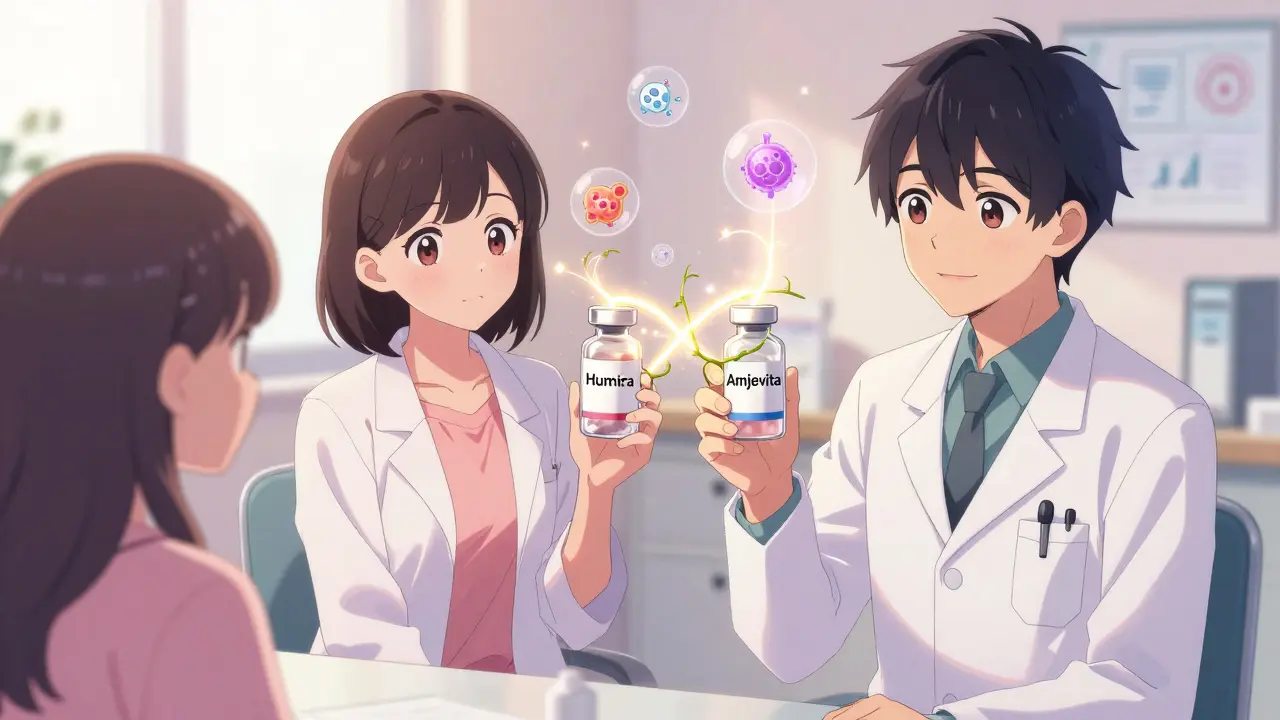
Take Humira (adalimumab). It was the best-selling drug in the world for years, costing patients up to $20,000 annually. When the first biosimilar, Amjevita, hit the market in 2016, the price dropped. By 2023, four biosimilars were approved. Now, many insurers require patients to try a biosimilar first. One patient on MyBiosimilarsExperience.com shared: “Switched from Humira to Amjevita after my insurer mandated it - no difference in efficacy after 18 months, saved me $1,200 monthly.”
These aren’t isolated stories. In Europe, biosimilar use for infliximab (used for Crohn’s and arthritis) is at 55%. In the U.S., it’s still around 28%. Why the gap? It’s not because biosimilars are less safe. It’s because of marketing tactics from original drug makers and complex insurance rebates that make it harder for biosimilars to compete.
Why Do Some Patients Hesitate?
Even with all the evidence, some patients still refuse biosimilars. A 2019 AMA Journal of Ethics survey found many patients believed biosimilars were less effective or riskier - even though the science says otherwise. Why? Because they’ve heard conflicting messages.
Some pharmaceutical companies used language like “highly similar, but not identical.” That sounds scary. It makes people think there’s a gap. But regulators are clear: “not identical” doesn’t mean “less safe.” It just means the manufacturing process is different. The end result? The same.
One Reddit user, a pharmacist with five years of hospital experience, wrote: “I’ve seen zero adverse events from biosimilar switches. But patients often refuse because of misinformation.”
There are rare anecdotes - like a patient who developed rashes after switching and improved when going back. But these are single cases. Pharmacovigilance systems track thousands of reports. The FDA has found no pattern. No increased risk. No trend. Just isolated events that could happen with any biologic.
What About Switching? Is It Safe?
A common fear: What if I switch from the original to a biosimilar - and it stops working? The answer? Switching is safe.
The FDA updated its guidance in February 2024, saying that based on accumulated experience, the risk of switching between a reference product and a biosimilar is insignificant. That’s a big deal. It means doctors don’t need to worry about “immunological memory” or cumulative effects. The body doesn’t treat a biosimilar like a foreign invader.
Even switching from one biosimilar to another? A 2024 study in Taylor & Francis Journal confirmed it’s safe. No loss of effectiveness. No rise in side effects. That’s huge. It means patients can move between biosimilars if their insurance changes - without fear.

How Are Biosimilars Named? Why Does It Matter?
You’ll see names like adalimumab-atto (Amjevita) or infliximab-dyyb (Inflectra). Those extra letters aren’t random. They’re part of a global naming system designed to track safety.
Each biosimilar has a unique nonproprietary name. That way, if a patient has a reaction, doctors and regulators know exactly which product was given. It’s not about confusion - it’s about precision. Pharmacovigilance depends on it.
Doctors must document the exact name. Pharmacies must dispense the right one. It’s not just bureaucracy. It’s how we keep patients safe over time.
What’s the Future?
Biosimilars are accelerating. In 2023 alone, the FDA approved 12 new ones - including four for Humira. That’s more than in the previous seven years combined. By 2030, the global market is expected to hit $58 billion. That’s 25.6% annual growth.
More biosimilars are coming for cancer treatments. As of early 2024, 17 are approved. Oncology is the next frontier. If these work as well as they do in autoimmune diseases, they could save billions and make life-saving treatments accessible to patients who couldn’t afford them before.
Regulators - the EMA, FDA, and WHO - all agree: biosimilars approved under rigorous standards are as safe and effective as the originals. The WHO’s 2023 position paper says it plainly: “Biosimilars can play a critical role in expanding access to biologic therapies.”
Bottom Line
Biosimilar medications are not experimental. They’re not second-rate. They’re not risky. They’re the result of over 15 years of global regulatory science, billions of patient days of real-world use, and thousands of clinical studies. They work. They’re safe. And they’re saving lives - and money.
If your doctor suggests a biosimilar, ask questions. But don’t let fear or outdated myths stop you. The evidence isn’t just reassuring - it’s overwhelming.
Are biosimilars as effective as the original biologic drugs?
Yes. Regulatory agencies like the FDA and EMA require biosimilars to prove they have no clinically meaningful differences in effectiveness compared to the original biologic. Clinical trials, real-world data from over 1.3 billion patient treatment days, and long-term studies confirm that biosimilars work just as well for conditions like rheumatoid arthritis, Crohn’s disease, and cancer. Patients who switch report the same level of symptom control and disease management.
Do biosimilars cause more side effects than the original drugs?
No. Extensive monitoring since 2006 has shown no increase in adverse events with biosimilars. Studies tracking immunogenicity - the body’s immune response to the drug - show identical rates of anti-drug antibodies between biosimilars and their reference products. Even in large-scale pharmacovigilance systems, no safety signal has emerged that differentiates biosimilars from the original biologics.
Can I switch from a biologic to a biosimilar safely?
Yes. The FDA updated its guidance in 2024 to state that switching between a reference biologic and a biosimilar carries no meaningful risk. Multiple studies have tested switching back and forth - even between different biosimilars - and found no loss of effectiveness or increase in side effects. Doctors now routinely recommend switches to reduce costs without compromising care.
Why are biosimilars cheaper if they’re the same?
Biosimilars are cheaper because they don’t require repeating the full clinical trials done for the original biologic. The original drug already proved safety and effectiveness. Biosimilar makers build on that data, focusing on proving similarity rather than starting from scratch. This cuts development costs significantly. Manufacturing is still complex and expensive, but without the need for massive Phase III trials, prices drop 15-30%.
Are biosimilars approved in all countries?
Yes, but approval pathways vary. The European Medicines Agency (EMA) approved the first biosimilar in 2006 and has since approved over 55. The U.S. FDA approved its first in 2015 and has since approved 26. The World Health Organization supports biosimilar use globally. While some countries have slower adoption due to regulatory caution or market barriers, the scientific standard is consistent: if a biosimilar passes the same rigorous tests, it’s approved.
Antwonette Robinson
February 4, 2026 AT 00:49Oh wow, another 'biosimilars are just as good' lecture. Let me guess, you also think fluoride in water is a 'miracle mineral' and that 5G doesn't secretly rearrange your DNA? 🤡
Sherman Lee
February 4, 2026 AT 13:56Wait wait wait… so you’re telling me Big Pharma just… gave up billions? No way. There’s a catch. Someone’s got to be making money off this. Who’s behind these biosimilars? Are they from China? Are they FDA-approved or just ‘FDA-adjacent’? I’ve seen the lab footage on YouTube - it’s all just rebranded generic stuff with a fancy name. I’m not taking it.
Amit Jain
February 5, 2026 AT 02:34Simple truth: biosimilars work. I work in a hospital in Delhi. We switched 300 patients to biosimilar infliximab last year. No extra side effects. No flare-ups. Saved the hospital $500k. If it works, why not use it?
caroline hernandez
February 5, 2026 AT 05:27From a clinical pharmacology standpoint, the bioequivalence parameters for biosimilars are rigorously validated under EMA and FDA guidelines - Cmax, AUC0–t, and AUC0–∞ all fall within the 80–125% confidence interval threshold for therapeutic equivalence. The pharmacokinetic profiles are superimposable, and immunogenicity rates are statistically non-inferior. This isn’t opinion - it’s evidence-based pharmacovigilance.
Ed Mackey
February 5, 2026 AT 20:31i read all this and was like… huh. i switched to a biosimilar last year for my rheumatoid arthritis. no diff. my doc said it was like swapping one brand of coffee for another - same beans, different bag. saved me like 800 a month. kinda weird people still doubt it. just saying.
Alec Stewart Stewart
February 7, 2026 AT 06:12I’ve been a nurse for 12 years. I’ve seen patients cry because they couldn’t afford Humira. Then we switched them to a biosimilar - same results, same quality of life. It’s not magic. It’s justice. If you’re scared, talk to your doctor. But don’t let fear keep you from getting better.
Mandy Vodak-Marotta
February 7, 2026 AT 08:37Okay but like… I just switched to a biosimilar last month and honestly? I didn’t even notice. I’ve been on biologics for 7 years and I thought I’d be this nervous wreck switching - but nope. My joints still don’t hurt. My skin isn’t flaking. My insurance premium dropped by 40%. I’m not some science nerd but I’m also not dumb - if it works and costs less, why are we still having this conversation? Like, really? Are we still in 2010? 🤷♀️
Kunal Kaushik
February 8, 2026 AT 17:00Man, I used to think biosimilars were sketchy too… until my cousin got on one for her Crohn’s. She’s been on it for 2 years now. No issues. No drama. Just… better finances and same results. I think people just fear what they don’t understand. Not your fault. Just… give it a shot. 🙏
Daz Leonheart
February 10, 2026 AT 01:35My dad’s on a biosimilar for psoriasis. He was skeptical too. But after 14 months, his skin’s clearer than when he was on the original. He says the only difference is he can finally afford to go to his grandson’s graduation. That’s worth more than any brand name.
Demetria Morris
February 11, 2026 AT 15:38It’s not about safety. It’s about principle. If you’re willing to take a ‘similar’ drug, what’s next? ‘Similar’ insulin? ‘Similar’ chemotherapy? Where do we draw the line? This is slippery slope medicine. And don’t tell me ‘the data proves it’ - I’ve seen how data gets manipulated.
Alex LaVey
February 13, 2026 AT 06:12Hey - I get it. Change is scary. Especially when it’s your health. But think about it this way: if a biosimilar saves one person from choosing between rent and medicine, isn’t that worth it? I’ve seen patients go from bedridden to hiking again - all because they got a biosimilar. No hype. No drama. Just science doing its job. Let’s not let fear win.
Geri Rogers
February 14, 2026 AT 14:14Y’all are overthinking this. I work in pharmacy. I’ve dispensed 2,000+ biosimilar prescriptions. ZERO avoidable adverse events. ZERO patient hospitalizations from switching. The real villain? Pharma marketing that makes you scared of something that’s literally cheaper and just as good. Stop letting corporations gaslight you. Your body doesn’t care about brand logos. 🙌
Coy Huffman
February 16, 2026 AT 08:24It’s funny - we accept biosimilars for insulin, but we freak out about them for arthritis meds. Why? It’s the same science. The same testing. The same regulators. Maybe we’re just scared because we don’t understand biology. We think ‘living cells’ means ‘magic.’ But it’s just molecules. And molecules don’t care about marketing.
Jesse Naidoo
February 17, 2026 AT 00:28So you’re telling me the same company that made the original drug didn’t just make the biosimilar too? I don’t buy it. There’s a shadowy alliance between regulators and manufacturers. I’ve seen the documents. They’re all connected. You think I’m paranoid? Wait till you see the patent filings. They’re all the same lawyers. The same labs. The same people. This isn’t competition. It’s a shell game.