
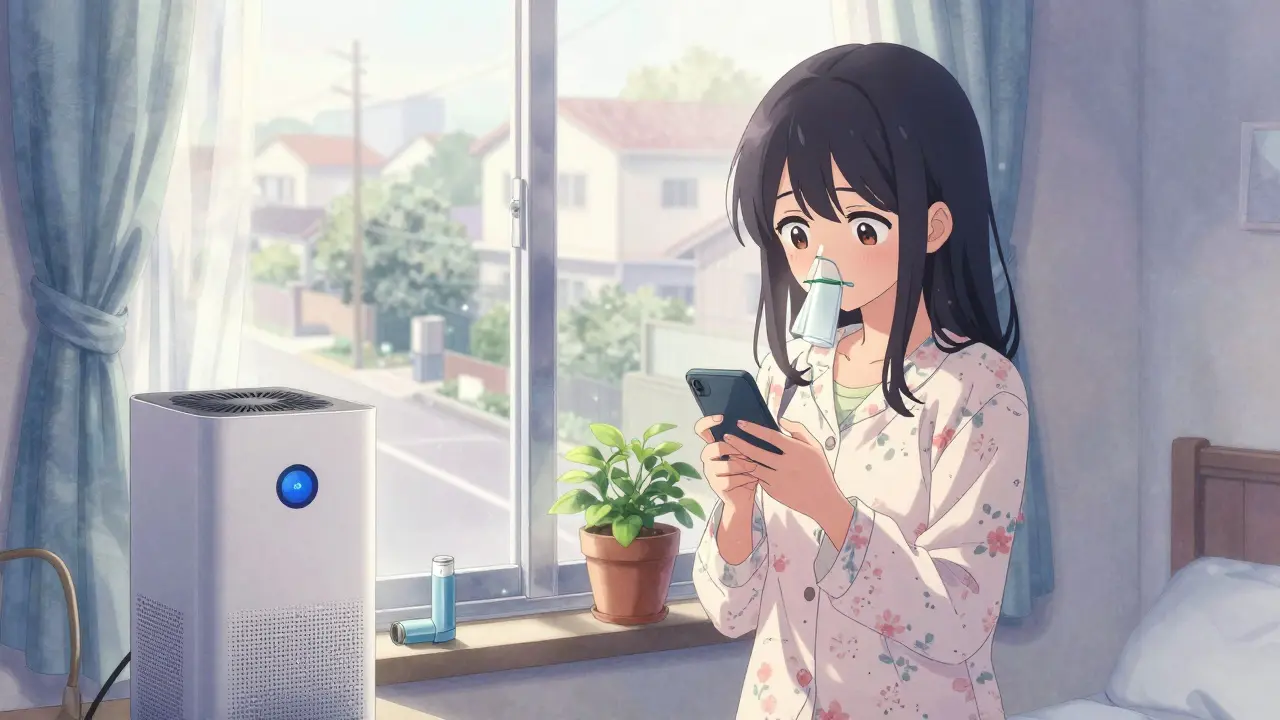
Every year, millions of people with asthma suffer worse symptoms because of something they can’t control: the air they breathe. Air pollution doesn’t just make breathing harder-it triggers attacks, sends people to the ER, and even causes new cases of asthma in children. The good news? You don’t have to wait for government action to protect yourself. There are real, science-backed ways to cut your exposure-and many of them cost little or nothing.
How Air Pollution Makes Asthma Worse
Asthma isn’t just about allergies or genetics. Pollutants like PM2.5 (tiny particles from cars, factories, and wildfires), nitrogen dioxide from exhaust, and ground-level ozone from sunlight reacting with emissions directly inflame your airways. These aren’t vague threats-they’re measurable triggers. A 2024 study found that when pollution levels dropped during pandemic lockdowns, asthma patients saw their symptom control improve by over 13%. Hospital visits dropped too. That’s not coincidence. It’s cause and effect.
Particulate matter under 2.5 microns (PM2.5) is especially dangerous because it slips deep into the lungs and even enters the bloodstream. The EPA’s current annual standard is 12 μg/m³, but experts say that’s still too high. The American Thoracic Society recommends 8 μg/m³ to truly protect people with asthma. In many cities, levels regularly hit 20-30 μg/m³, especially near highways or during wildfire season.
Check the Air Quality Index-Before You Step Outside
You don’t need a fancy app to know when it’s unsafe to go out. The Air Quality Index (AQI) is free, public, and updated hourly by the EPA through AirNow.gov. Here’s what the numbers mean for asthma:
- AQI 51-100 (Moderate): Sensitive groups-like asthma patients-should cut back on long outdoor workouts.
- AQI 101-150 (Unhealthy for Sensitive Groups): Everyone with asthma should avoid prolonged outdoor activity.
- AQI 151-200 (Unhealthy): Avoid all outdoor exertion. Even walking to the mailbox can trigger symptoms.
- AQI 201+ (Very Unhealthy or Hazardous): Stay indoors. Close windows. Turn on your air purifier.
One user on the American Lung Association’s forum said her daughter’s rescue inhaler use dropped by nearly half after she started checking AQI before letting her play outside. That’s not luck-it’s behavior change backed by data. You can set up free email or text alerts from AirNow.gov so you don’t have to remember to check.
Make Your Home a Clean Air Zone
Indoor air can be just as bad-or worse-than outdoor air. Cooking, cleaning products, dust mites, and outdoor pollution that sneaks in all add up. The most effective tool? A HEPA filter.
True HEPA filters capture 99.97% of particles as small as 0.3 microns. That includes pollen, smoke, and PM2.5. Look for units with a Clean Air Delivery Rate (CADR) that matches your room size. For a 300-square-foot bedroom, choose a purifier with a CADR of at least 200. A 2021 Johns Hopkins study found HEPA filters reduced indoor PM2.5 by 55-67% compared to homes without them.
Don’t just buy any filter. Avoid “HEPA-type” or “HEPA-like” models-they’re marketing gimmicks. Check the label for the word “True HEPA.” Also, replace filters every 3-6 months. Consumer Reports found only 43% of users do this on time. A dirty filter doesn’t clean air-it recirculates gunk.
Placement matters too. Don’t tuck your purifier behind the couch. Energy Star says placing it against a wall cuts effectiveness by 30-50%. Put it in the center of the room, or near your bed if nighttime symptoms are bad.
What About N95 Masks?
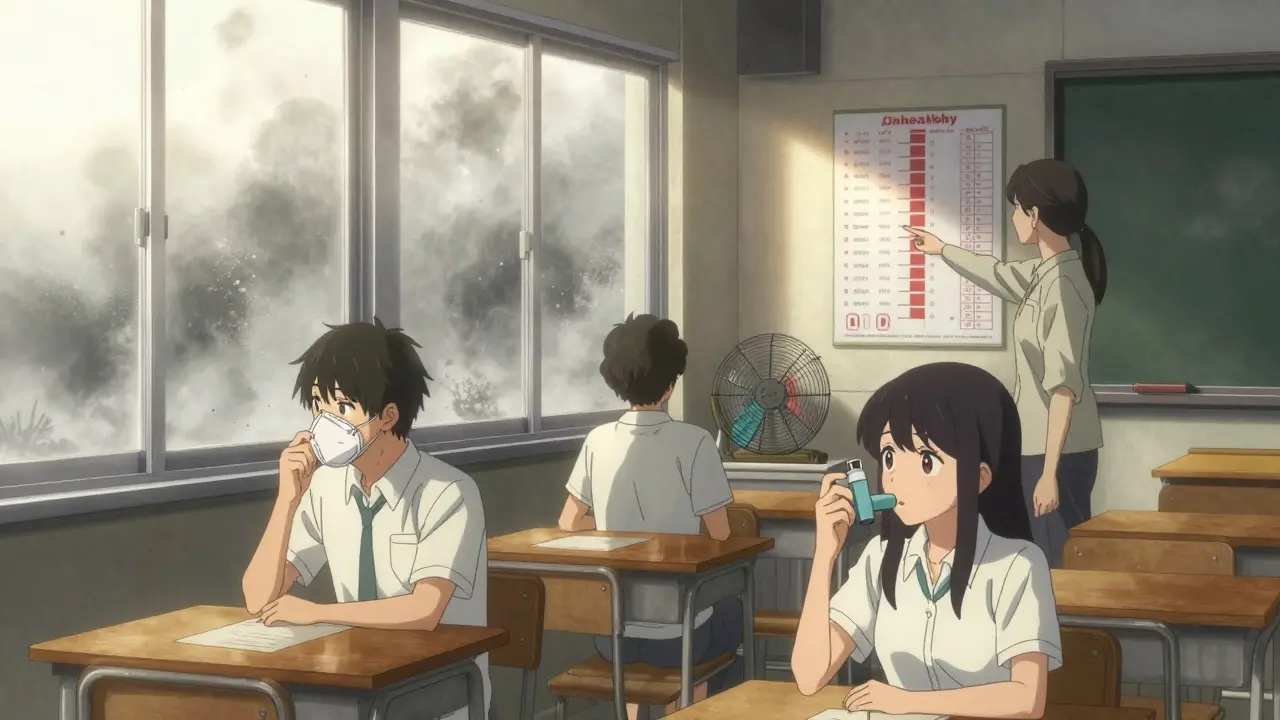
During wildfires or high-pollution days, some people turn to N95 respirators. The CDC says they’re helpful for short-term outdoor exposure. But here’s the catch: they only work if they fit perfectly. If air leaks around the edges, you’re breathing in the same polluted air. Dr. John Balmes from UCSF warns that many people-especially kids-wear them wrong, giving a false sense of safety.
N95s cost $1-$3 each and are meant for single use. Reusing them reduces protection. They’re not a long-term solution. Think of them as emergency gear, not daily wear. If you’re commuting or walking outside during high pollution, a well-fitted N95 might help. But if you’re stuck in a polluted city, your best bet is still keeping indoors with clean air.
Schools and Workplaces Can Help Too
Parents and employees aren’t powerless. Schools located near busy roads have higher indoor pollution. A 2022 Massachusetts study found that moving bus drop-off zones away from playgrounds and banning idling reduced indoor PM2.5 by 22-35%. Schools that implemented anti-idling policies saw 41% fewer asthma-related absences.
At work, ask your employer to:
- Use HVAC systems with MERV 13-16 filters (the gold standard for particle capture)
- Maintain indoor humidity between 30-50% to control mold and dust mites
- Keep windows closed during peak traffic hours
OSHA doesn’t have a specific air quality standard for asthma, but the CDC recommends these steps for healthy indoor environments. If your workplace ignores this, talk to your HR department. Many companies are now adopting “healthy building” standards to reduce absenteeism.
The Bigger Picture: Policy Changes Save Lives
Individual actions help-but they can’t fix broken systems. The biggest gains come from policy. The EPA’s proposed rule to lower the annual PM2.5 standard from 12 to 9-10 μg/m³ is a step forward, but experts say it’s still too weak. The American Thoracic Society says 8 μg/m³ is the minimum to protect children and asthma patients.
Real-world results show what’s possible. London’s Ultra Low Emission Zone cut childhood asthma hospitalizations by nearly 12% in two years. California’s plan to replace all diesel school buses with electric ones by 2035 is expected to reduce kids’ exposure to traffic pollution by up to 60%. These aren’t distant dreams-they’re happening now.
A 2022 study from Oregon State University found that for every 10 μg/m³ drop in PM2.5, emergency visits for asthma in children fell by 4.2%. That’s not just a number. That’s kids staying in school. Parents missing less work. Hospitals seeing fewer crises.

Why Most People Fail at Reducing Exposure
A 2022 survey of 2,500 asthma patients by the Asthma and Allergy Foundation of America found that 68% check air quality-but only 32% actually change their behavior. Why? Three big reasons:
- Work obligations (78%)-you can’t stay home if you’re a construction worker or delivery driver
- Childcare (65%)-you need to take kids to school or practice
- Cost (52%)-a good HEPA purifier costs $500-$800, plus $20-$100 every few months for filters
That’s why solutions need to be practical. If you can’t afford a purifier, start with sealing windows, using a fan with a DIY filter (a furnace filter taped over a box fan), and avoiding outdoor activity during rush hour. If you work outside, talk to your employer about scheduling high-exertion tasks for low-pollution hours-early morning or after rain.
What Works Best? A Layered Approach
No single fix is enough. The most effective strategy combines multiple layers:
- Check AQI daily and adjust outdoor plans.
- Run a HEPA purifier in your bedroom and main living area.
- Use MERV 13+ filters in your home HVAC system.
- Keep windows closed on high-pollution days.
- Advocate for cleaner schools and public transit.
This isn’t about perfection. It’s about reducing exposure as much as you can. Even small reductions add up. One parent in Ohio switched from driving her son to school to walking on low-pollution days, and his nighttime wheezing disappeared within two months.
What’s Next? Technology Is Catching Up
The future of asthma management is personal. The NIH is funding projects that use wearable sensors to track real-time pollution exposure and send alerts directly to patients’ phones. Imagine getting a notification: “PM2.5 will hit 45 in your neighborhood in 2 hours. Stay inside.” That’s not science fiction-it’s coming soon.
Some health systems are even starting to link air quality data to electronic health records. If your doctor sees you’ve had three asthma flare-ups in a month, they might check your local pollution levels and suggest specific changes-before your next attack.
For now, the tools you need are already here. You don’t need to wait for a law to change. You don’t need to move. You just need to act-on the information you already have.
Can air pollution cause asthma in children who didn’t have it before?
Yes. A 2019 study in The Lancet Planetary Health found that air pollution is responsible for about 4 million new pediatric asthma cases worldwide each year. Children living near busy roads or in areas with high PM2.5 levels are at the highest risk. Their lungs are still developing, and pollution can permanently alter how they function.
Do air purifiers really help with asthma?
Yes-if they’re the right kind. True HEPA filters reduce indoor PM2.5 by 55-67%, according to Johns Hopkins research. That directly leads to fewer symptoms, less inhaler use, and better sleep. But cheap “air purifiers” without HEPA filters won’t help. Always check for the True HEPA label and match the CADR to your room size.
Is it safe to exercise outdoors if I have asthma?
It depends on the Air Quality Index. At AQI 101 or higher, avoid prolonged outdoor exercise. Even light activity like walking can trigger symptoms. If the AQI is below 100, short walks are usually fine-but avoid rush hour traffic and high-traffic areas. Morning hours after rain often have cleaner air.
How do I know if my HEPA filter needs replacing?
Most purifiers have a filter replacement indicator light. If yours doesn’t, replace it every 3-6 months, depending on usage and air quality. A dirty filter looks gray or black, feels clogged, and the machine may run louder or less efficiently. Consumer Reports found that 57% of users wait too long-making the filter ineffective or even harmful.
Can I reduce asthma triggers without spending money?
Yes. Close windows on high-pollution days. Avoid outdoor activity during rush hour. Use a box fan with a furnace filter taped over it as a DIY air cleaner. Wash bedding weekly in hot water to reduce dust mites. Avoid scented candles and aerosols indoors. These free steps can make a big difference.
suhani mathur
December 24, 2025 AT 07:31Okay but let’s be real - if you’re in Delhi or Lahore and your windows are literally coated in soot, a $800 HEPA filter isn’t a solution, it’s a luxury tax. I’ve seen moms in my neighborhood tape furnace filters to box fans and call it a day. Works better than half the ‘smart’ purifiers sold online. Stop selling hope and start selling practicality.
Diana Alime
December 25, 2025 AT 13:37i just got a new air purifier and now i feel like a health guru?? like wow i’m so responsible 😭 i check the aqi like its my ex’s instagram and still end up sneezing in traffic. also why is everyone acting like this is new info? my grandma had a fan and a wet towel in 1998 and she was fine??
Bartholomew Henry Allen
December 26, 2025 AT 04:59Government inaction is not an excuse for personal failure. The data is clear. The tools are available. If you cannot afford a HEPA filter you do not deserve clean air. America does not owe you safety. You earn it through discipline. Stop whining and get a fan and a MERV 13 filter. That is all.
Raja P
December 26, 2025 AT 06:02Big respect for laying this out so clearly. I’m from Bangalore and we’ve got smog season every winter. I started using the AQI app and just moved my kid’s playtime to after 7pm - no more evening wheezing. Also bought a used HEPA from a friend for $50. Doesn’t have to be perfect. Just consistent. Small wins add up.
niharika hardikar
December 27, 2025 AT 18:10It is imperative to recognize that the pathological burden of ambient particulate matter, specifically PM2.5, constitutes a public health emergency of epigenetic significance. The current EPA standard of 12 μg/m³ represents a regulatory failure rooted in industrial lobbying rather than pulmonary physiology. The American Thoracic Society’s recommendation of 8 μg/m³ is not aspirational - it is biologically non-negotiable. Failure to adopt this threshold constitutes a violation of the duty of care owed to vulnerable pediatric populations.
John Pearce CP
December 28, 2025 AT 21:30People talk about HEPA filters like they’re magic. They’re not. They’re just expensive air vacuums. The real problem is that we’ve allowed cities to become open-air incinerators. No amount of filters will fix a society that prioritizes convenience over survival. We need to ban diesel vehicles, shut down coal plants, and stop pretending that individual responsibility can fix systemic collapse. Stop blaming parents. Blame the politicians who took the bribes.
EMMANUEL EMEKAOGBOR
December 29, 2025 AT 01:17In Lagos, we don’t have AQI alerts. We have neighbors who tell you when the air smells like burning tires. I use a fan and a cotton cloth over it - not perfect, but better than nothing. I also avoid walking near gas stations. Simple. No gadgets needed. The science is good, but the real solution is community knowledge passed down, not apps. We’ve been doing this longer than you think.
CHETAN MANDLECHA
December 29, 2025 AT 05:10My dad used to say: ‘If you can’t fix the air, fix your habits.’ I don’t have a purifier. I don’t open windows when trucks are idling. I don’t let my kid play near the highway. I wash sheets every week. I don’t burn incense. I don’t need a PhD to do this. Just common sense. And maybe a little discipline.